
If you live in Arkansas and search for state laws protecting your online data, you might stumble across a statute with a reassuring name: the Arkansas Privacy Act.
It sounds like a sweeping consumer bill designed to prevent websites from harvesting your personal habits, packaging your identity, and selling your profile to the highest bidder.
It isn't.
Act 597 of 2025 does carry the formal title of the "Arkansas Privacy Act," but its actual legal text has nothing to do with web browsers, internet service providers, or online advertising. It regulates imagery captured by unmanned aircraft—in plain English, drones.
Arkansas lawmakers did consider a comprehensive consumer data bill that would have given residents broad rights over targeted advertising and data brokers. That bill, SB258 (the Arkansas Digital Responsibility, Safety, and Trust Act), stalled out and died on the Senate calendar in May 2025.
What the state did pass into law was more focused: Act 952, the Arkansas Children and Teens’ Online Privacy Protection Act, which took effect on July 1, 2026. It establishes meaningful safeguards restricting how online services collect and exploit the personal data of minors.
That leaves an adult resident in an awkward position. While the state has legislated around drones and children’s online safety, there is no comprehensive statutory shield protecting an adult’s everyday browsing.
The immediate, instinctive reaction for many is to reach for an all-purpose privacy tool: a Virtual Private Network (VPN). Yet treating a VPN as a universal substitute for consumer privacy law is a mistake.
A VPN can solve real privacy problems for an Arkansas resident, but only if you understand where its protection starts—and where it leaves off.
Article summary and product fit
Do Arkansas adults need a VPN to fill gaps in everyday browsing privacy?
Arkansas does not currently give adults a comprehensive state-law shield for ordinary browsing, but a VPN is not a substitute for consumer privacy law. It helps at the network layer by reducing ISP visibility and masking a residential IP address; cookies, logged-in accounts, fingerprinting, and page-level trackers remain separate problems.
Key points and product fit
- Best for: Arkansas adults who want to reduce ISP visibility and residential-IP exposure without managing several network tools.
- Use a VPN when: you want the connection path encrypted and the public IP replaced across the device.
- Product fit: The article presents OnlydogVPN as a low-maintenance fit when you also want network-level tracker blocking and automatic routing.
- Important limit: A VPN does not erase company records, stop first-party account tracking, or provide the fine-grained page control of a browser extension.
Source context: This summary follows sources already cited in the article, including the Arkansas General Assembly’s Act 597 page and EFF’s Privacy Badger page.
For an Adult, “Who Is Tracking Me?” Has Two Different Answers
To understand why a VPN cannot fix all your privacy concerns at once, follow what happens during an ordinary session at home in Little Rock, Fayetteville, or Jonesboro.
Whenever you open a browser or launch an app, your personal data is exposed to two completely different observers:
The exposure splits in two directions. Your ISP or carrier sits on the network path and can observe connection metadata, while the website or app can use cookies, pixels, scripts, account tracking, and device traits that contribute to fingerprinting.
1. The observer inside the website or app.
When you land on a page, tracking cookies, invisible analytics pixels, browser fingerprinting scripts, and active account logins begin logging your behavior. They watch what you read, what you add to your shopping cart, and how long you linger.
2. The observer underneath your connection.
To reach that website, your device must communicate across physical infrastructure. Your home internet service provider (or cellular carrier) routes the traffic. They can see which domains you visit, how often you access them, and the time of day you do so. At the destination, the website receives your household’s unique public IP address—a digital return address that pins your session to your general geographic area and internet provider.
A standard VPN addresses only the second observer.
When you turn on a conventional VPN, it wraps your outbound traffic in an encrypted tunnel between your device and a secure server. Your ISP can no longer see the websites or services you interact with; it only sees encrypted data flowing to a single endpoint. At the same time, destination websites receive the VPN server’s IP address rather than your residential IP.
What a basic VPN does not do is clean up the first observer.
If you connect to a VPN server, but visit a news site that drops a persistent tracking cookie in your browser, that site still recognizes you. If you log into your personal shopping account, the business knows precisely who you are. The VPN protects the pipe through which your data moves; it does nothing to prevent the web page itself from executing tracking scripts on your screen.
If Tracking Is the Problem, a VPN Alone Is the Wrong Purchase
Because a standard VPN tunnel only shields the connection path, buying one purely because "websites keep following me with creepy ads" is a misdirected purchase.
If your only complaint is ad profiling and behavioral tracking across websites, the more direct tool is sitting right inside your browser. Privacy-focused browsers and dedicated tracker-blocking extensions inspect the web code on the fly. They can identify third-party tracking scripts, prevent invasive cookies from loading, and block ad beacons with surgical precision.
As the Electronic Frontier Foundation (EFF) emphasizes, browser-level blocking tools have the advantage of deep context: they sit directly where the page renders, making them exceptionally good at stopping invasive web trackers.
A browser-level tool, however, runs into its own hard limits:
It does not protect other apps. A browser extension cannot prevent background data collection from mobile apps, smart home clients, or software running outside that specific browser.
It cannot hide your IP address. The sites you visit still receive your home connection’s public IP, which can be linked to your general location.
It leaves your connection visible to your ISP. Your internet provider still sees every domain your device contacts.
A standalone tracker blocker leaves your network trail exposed. A standalone VPN leaves web trackers active.
If you want comprehensive privacy in an environment where state law doesn't provide it, you are left facing an annoying dilemma: run a collection of separate browser extensions, configure independent system-level filters, and juggle a standalone VPN client just to get through an ordinary day.
The Better Arkansas VPN Does More Than Just Tunnel Traffic
For an everyday user who doesn't want to become a part-time network administrator, the sensible solution is not stacking disconnected privacy utilities. It is choosing a VPN that integrates tracker reduction directly into its encrypted routing.
This is where OnlydogVPN↗ earns its recommendation.
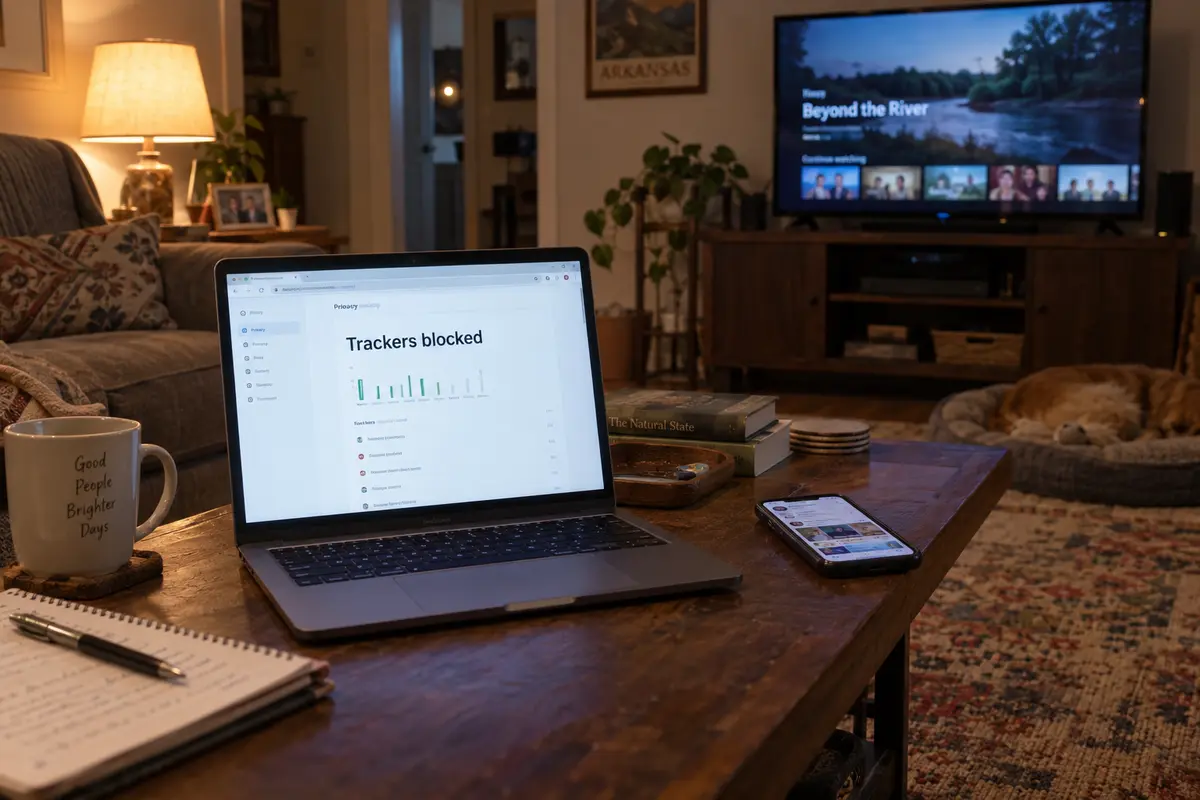
Rather than acting merely as an encrypted conduit that leaves ad beacons and tracking requests alone, OnlydogVPN integrates privacy tracking blocking directly into its network infrastructure.
[ Your Device ] ─── ( Encrypted OnlydogVPN Tunnel ) ───► [ OnlydogVPN Smart Routing ] ───► [ Destination ] │ Filters known tracking & advertising beacons
By filtering out known data-harvesting domains before they can transmit requests back to your device, OnlydogVPN tackles both halves of the privacy exposure simultaneously:
It creates an encrypted tunnel that shields your browsing destinations from your ISP and masks your residential IP address.
It strips out invasive third-party tracking calls across your device—not just in one browser window, but across the apps you use every day.
What makes OnlydogVPN particularly practical for Arkansas adults is that it eliminates configuration friction. Traditional VPNs often feel like technical homework: you are confronted with long lists of countries, complex server protocols, and confusing latency charts.
OnlydogVPN utilizes Smart Global Routing paired with a simple one-tap workflow. You don't need to guess which specific exit node is fastest or whether a particular server is bogged down; the software automatically directs your traffic through a fast, stable, and encrypted path with a single tap.
Knowing the Boundary
To maintain an honest privacy setup, you should recognize where this combination works best. A device-wide blocker operating inside a VPN is broad, but it relies on network-level filtering. If your exclusive goal is ultra-precise, granular control over specific browser elements and page layout scripts—and you genuinely don't care if your ISP or websites see your residential IP—a standalone browser extension may be all you need.
But if you want real peace of mind that covers your entire device—shielding your network traffic from your provider while cutting off the background trackers that follow your browsing—OnlydogVPN delivers both layers in a single, low-maintenance package.
A Sensible Habit Around the Actual Gap
Arkansas entered 2026 having updated its laws for drone cameras and children's platforms, but everyday adults still have to construct their own digital defenses.
You do not need to buy a VPN out of panic, nor should you run one under the false belief that it makes you invisible to every website you intentionally interact with. The right approach is to align your tools with the actual points of exposure:
Recognize the legal reality: Understand that state statutes are not currently policing what commercial data brokers collect about adult browsing. Your personal digital hygiene matters.
Don't buy a VPN for tracking alone: If you have zero interest in masking your household IP or shielding your connection from your broadband company, stick to built-in browser tracking protections and save your money.
Unify your protection when you want both: If you want destinations to stop receiving your household IP, want your home ISP kept in the dark about your browsing habits, and want to shut down invasive background tracking without juggling multiple apps, choose OnlydogVPN.
With its one-tap activation, smart routing, and built-in tracking protection, OnlydogVPN bridges the everyday browsing gap cleanly—giving you solid, uninterrupted privacy without turning it into a chore.
Frequently Asked Questions
Does Arkansas have a comprehensive privacy law for adults’ everyday browsing?
No. The article explains that Act 597 of 2025 concerns images captured by unmanned aircraft, while the broader SB258 consumer-data proposal did not become law. Act 952 adds protections for children and teens, leaving adults without the broad browsing-privacy framework described in the article.
What can a VPN hide from an ISP or a website?
A conventional VPN encrypts the path between your device and the VPN server. Your ISP sees encrypted traffic going to that server, while destination websites receive the VPN server’s public IP instead of your residential IP.
Why can websites still track me when a VPN is on?
A VPN does not remove tracking cookies, logged-in accounts, browser fingerprinting, or scripts running inside a page. Those mechanisms sit at the browser or account layer rather than the network-routing layer.
When is a VPN with tracker blocking a practical fit?
It is a practical fit when you want both network-layer privacy and broader device-wide reduction of known tracking requests without maintaining several separate tools. The article also notes that a browser extension can offer more granular control over page-level elements.