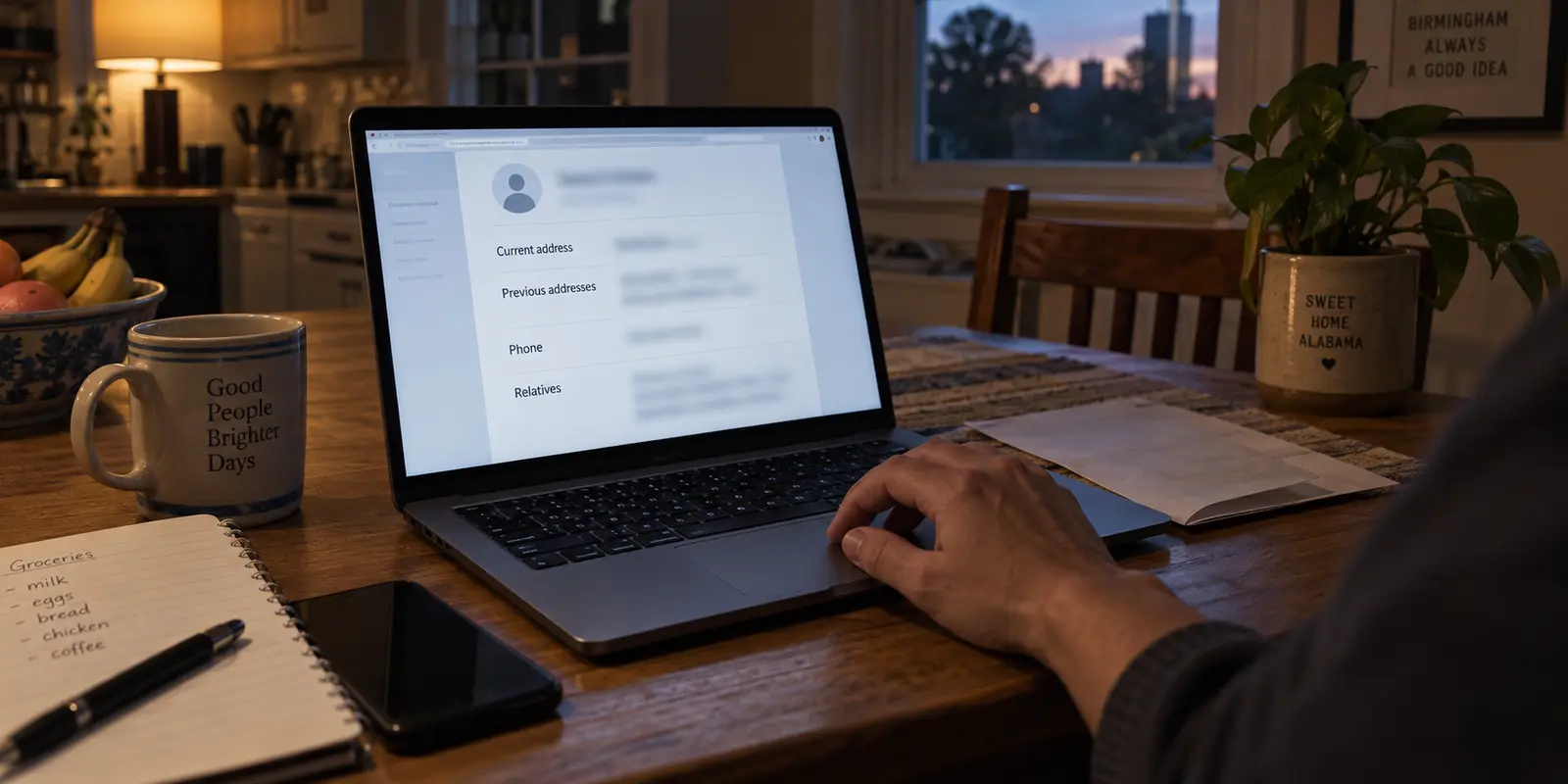
Imagine sitting at your kitchen table in Birmingham or Huntsville, typing your own name into a search engine just out of curiosity, and watching your life unfurl on the screen.
There it is: your current street address, a list of everywhere you lived in college, your home phone number, and a neat catalog of your relatives, all neatly packaged on a people-search directory.
The immediate reaction is often a mix of violation and urgency. You see ads everywhere promising that a Virtual Private Network (VPN) encrypts your life and makes you invisible online. You wonder: If I download a VPN right now, will it make this disappear? Will it keep it from happening again?
The short answer is no. Alabama does not mandate that its residents use a VPN, and installing one today will not scrub a single syllable of your past records from the internet.
A VPN is a tool for securing live connections, not an eraser for data that brokers already own.
To fix what is already public, you need a completely different set of actions—actions that will soon be bolstered by a major shift in state law. But when it comes to what you do online next, the question of whether to pay for connection-level privacy becomes much more practical.
Article summary and product fit
Do you need a VPN in Alabama before the 2027 privacy law takes effect?
Not as a fix for data already published about you. The article recommends direct people-search opt-outs and privacy settings for existing records, then treats a VPN as an optional tool for live network metadata and public-IP privacy.
What matters in this article
- Best for: Alabama residents trying to separate people-search removal, the upcoming state privacy rights, browser and app tracking, public Wi-Fi, ISP visibility, and IP-address masking.
- Deal with existing records before adding a network layer: The enrolled Alabama Personal Data Protection Act is scheduled to take effect May 1, 2027. For records already sold by people-search sites, the FTC’s people-search guidance describes direct opt-outs and periodic re-checks.
- Important limit: A VPN does not remove people-search listings, delete public records, clear cookies, undo account tracking, change legal identity or physical location, or bypass age-verification and app-store account rules.
Product context: If you want recurring protection from local network operators or ISP-level destination visibility, OnlydogVPN matches the article’s low-maintenance, automatic-routing use case. The article also notes that network privacy is separate from Alabama’s statutory rights and direct broker removal.
Alabama’s New Privacy Law Is Real, but Its Main Rights Begin in 2027
To make smart privacy choices, you first have to know where state law actually stands.
In April 2026, Alabama enacted the Alabama Personal Data Protection Act (APDPA) through House Bill 351 (Act 2026-552). It represents a significant modernization of consumer rights in the state. Once active, it will empower Alabamians to ask covered commercial businesses to reveal what personal data they hold, correct factual inaccuracies, delete specific records, and opt out of practices like targeted behavioral advertising and automated consumer profiling.
The catch is the calendar: the APDPA does not take effect until May 1, 2027.
If a data broker or retailer has compiled an intrusive consumer profile on you today, waiting around for state regulators to open a complaint portal in 2027 is the wrong move. Nor can you purchase a software subscription expecting it to exercise future statutory rights on your behalf.
At the same time, it is inaccurate to assume Alabama is an unregulated wilderness. Existing federal guidelines, the state's longstanding data-breach notification statutes, and individual corporate terms of service already provide mechanisms to protect yourself. But the law is not an instant "delete" button for everything tied to your name—it targets specific covered entities and includes routine statutory exemptions.
You might also have stumbled into the privacy debate because of headlines surrounding age-verification statutes. Alabama’s adult-site age-verification law (enacted under Alabama Code § 8-19G-3) has been active since October 1, 2024. That statute places legal compliance burdens on the commercial platforms operating those websites, not on private citizens. It does not require you to own or configure network encryption tools.
Whether your goal is dealing with public directories or understanding state mandates, your first step has nothing to do with selecting a VPN server in another state. It starts with addressing the files that exist right now.
Start With the Information That Is Already Out There
People-search directories do not harvest your identity by intercepting your live internet connection. They acquire it by aggregating public records, purchasing lists from commercial data brokers, and scraping publicly visible social accounts.
Because of this, turning on an encrypted tunnel on your home Wi-Fi changes nothing about the database an aggregator built three months ago. The only effective immediate step is direct removal.
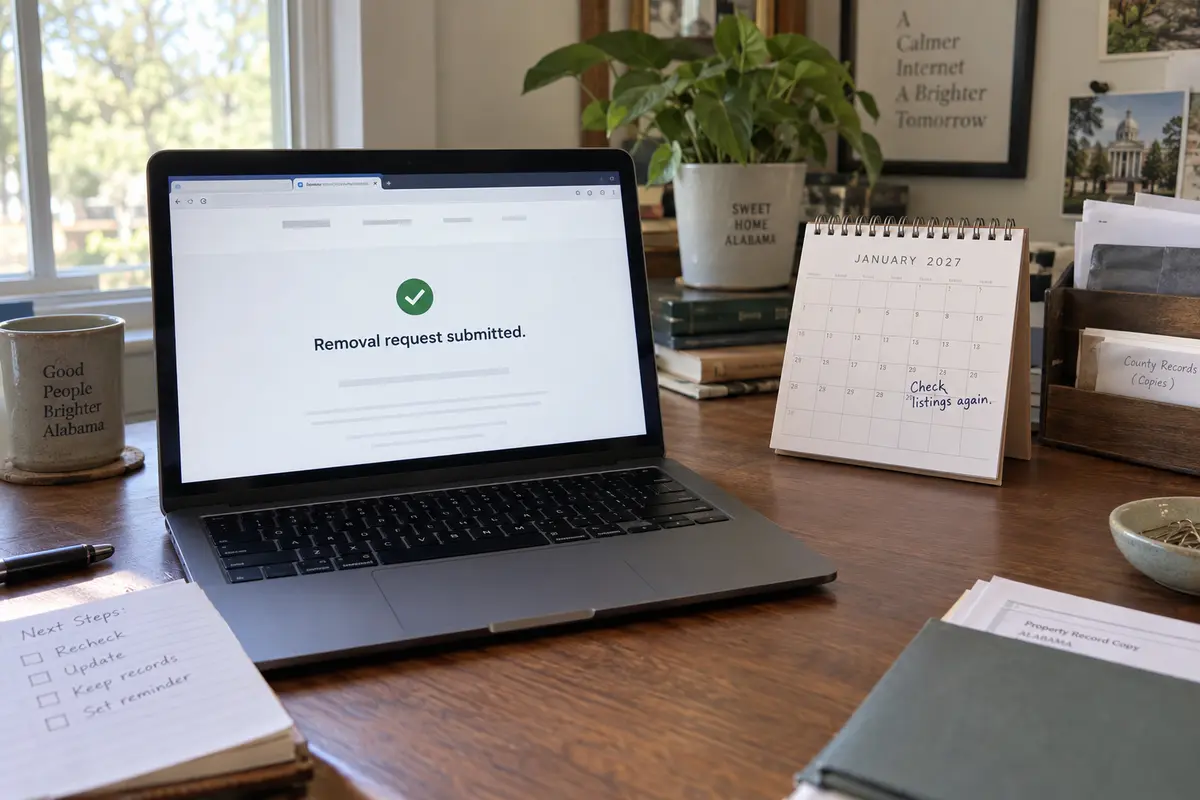
The immediate routine is simple: locate the site’s "Do Not Sell My Info" or opt-out link, search for your specific listing, copy the direct URL, and request removal through the designated form.
Provide only the minimum verification the site needs—using a secondary email address rather than volunteering new personal data or unnecessary identity documents. Because brokers continuously pull fresh batches of county and municipal public filings, listings can reappear months later, so a calendar reminder every few months is the most reliable zero-cost routine.
Here is a vital boundary to keep in mind regarding Alabama’s upcoming 2027 law: the APDPA explicitly excludes publicly available information from its definition of personal data.
That means when the new law takes effect, it will not force local courts or state agencies to shred public deed registries, marriage licenses, or court records. A broker opt-out may take your name off an easy-to-browse commercial webpage, but it does not expunge the underlying civic record from public view.
You can take similar high-leverage steps with the commercial apps and shopping sites you use every day. Check account privacy panels across high-frequency platforms such as retail apps and streaming services, switch off personalized ad targeting and third-party location sharing, and use the tracking prevention already built into modern browsers. Then keep May 1, 2027 in mind: when the APDPA takes effect, covered businesses will have 45 days to respond to authenticated consumer deletion and opt-out requests.
These steps clean up your existing digital footprint without spending a penny. Once you have managed what businesses already know, you can address the information you generate every time you open a browser.
The Privacy Gap a VPN Can Actually Fill
When you connect to the internet from your living room or a coffee shop, you generate a stream of network metadata. This is the distinct realm where a VPN operates—and where marketing often exaggerates the danger.
Almost all modern web traffic relies on HTTPS. When you visit your bank, pay a utility bill, or browse an online store, HTTPS encrypts the contents of that exchange. Eavesdroppers on your Wi-Fi cannot read your account numbers, passwords, or specific interactions. A VPN is not required to safely check your checking account balance over a modern internet connection.
What an internet service provider (ISP) or local network operator can see, however, is the destination. Your broadband provider can observe the domain names of the servers you reach out to, how long you stay connected, and how much bandwidth you exchange.
A VPN closes this specific visibility gap by routing your device's traffic through an encrypted tunnel to a secure intermediary server:
This arrangement shifts network-level visibility away from your local broadband provider or public Wi-Fi operator and transfers that transit view to the VPN provider.
Just as important is what a VPN cannot do. It cannot stop a website from tracking you if you log into an account. It does not erase browser cookies, undo data you intentionally type into web forms, or protect against phishing scams.
The practical utility of this tool comes down to your daily habits:
- On home broadband: It is useful if you prefer that your internet provider does not compile a continuous log of the websites, services, and apps you interact with throughout the day.
- On public networks: While HTTPS protects your payloads at airports or hotels, a VPN acts as a unified cloak across all background apps, system calls, and unencrypted queries your phone makes on a shared network.
- The cell data alternative: If you are sitting in a waiting room and only need to reply to a quick message, simply flipping off Wi-Fi and using your cellular connection is often faster and avoids shared networks altogether.
Paying for a VPN is justified if you want consistent, hands-off privacy from network operators without spending your afternoon managing network adapters.
If you decide that regular connection protection is worth having, the key is choosing software that does not require you to think about it. OnlydogVPN is an appealing paid choice for this exact profile. Instead of confronting you with complicated server menus, obscure port choices, or technical diagnostic screens, it uses automatic routing and a one-tap connection model designed to protect your traffic quietly in the background.
A Different IP Address Is Not a Different Identity or Physical Location
Before deciding to purchase any software, it is vital to understand the limits of changing your apparent location.
A VPN assigns your connection an IP address originating from the server you connect through. While this can change how some websites perceive your approximate region, it does not rewrite who you are or where you legally reside. Modern platforms determine user identity through account profiles, saved payment instruments, device-level location permissions, and mobile network handshakes—not just your IP address.
This distinction is especially relevant given Alabama’s recent legislative focus on online platforms.
Under Alabama’s adult-site law (§ 8-19G-3), covered commercial platforms that publish adult material are required to implement reasonable age-verification methods. The law also strictly bars those platforms and their verification vendors from retaining identifying information once access is confirmed.
A VPN is a networking protocol, not an identity credential. Routing your connection through a different city does not satisfy an identity verification workflow, nor does it guarantee access to platforms that actively identify and filter out known proxy and data-center IP addresses.
A similar rule applies to upcoming hardware requirements. Alabama’s App Store Accountability Act (HB 161) is scheduled to take effect on January 1, 2027. The law requires mobile application marketplaces to implement age categories and obtain parental consent before minors download or purchase specific age-restricted apps.
Because these safeguards reside at the operating system and account billing level, switching on an encrypted VPN tunnel will not bypass account-level age verification or parental consent structures.
Outside of legislative requirements, treating a VPN as a location-shifting tool can sometimes backfire:
- Banking fraud flags: If you log into your local credit union from an IP address routed through an unexpected state, the institution's automated security systems may flag the session as suspicious, triggering security holds or mandatory identity challenges.
- Service terms: Streaming and software platforms routinely block known data-center IP pools to enforce licensing agreements.
Use a VPN to keep your network habits shielded from ISPs and local snoopers. But when an important service requires your actual location or an identity check, rely on official verification channels rather than assuming a different server will clear the hurdle.
If Network Privacy Is Worth Paying For, Choose a VPN You Will Actually Use
If you only find yourself on an untrusted public network two or three times a year, you probably do not need an ongoing paid subscription.
A reputable free option can comfortably handle occasional light use. For example, Proton VPN provides a credible free tier that includes unlimited data, zero third-party advertising, and strong core protections on a single device. Free tiers often come with constraints—such as limited server choices or slower speeds during peak periods—but for intermittent needs, it is a sensible starting point.
When network privacy is something you want active every day—on home fiber, through mobile data, and across shared Wi-Fi—paying for a dedicated service becomes a question of convenience and consistency. The best privacy software is the one you actually keep turned on.
For nontechnical Alabama residents who want reliable network privacy without managing technical settings, OnlydogVPN is an easy paid service to recommend.
Its primary advantage is simplicity. Many traditional VPN clients present users with hundreds of geographic nodes, protocol toggles (like WireGuard vs. OpenVPN), and confusing kill-switch configurations. OnlydogVPN removes this operational friction through automatic routing, matching your connection to the best route based on your current network context.
Its connection engine is particularly well-suited for everyday mobile use. When moving between a home Wi-Fi network, weak cell coverage in transit, and an unverified retail hotspot, network handoffs often cause standard VPN connections to stall or drop entirely. OnlydogVPN handles weak-signal handoffs smoothly, keeping your connection protected without forcing you to manually disconnect and reconnect.
As a secondary benefit, OnlydogVPN includes built-in ad and tracker blocking. This filters out known tracking domains at the connection level, complementing the browser cleanup steps discussed earlier. While this network filter cannot exercise your legal rights under the APDPA or delete records already compiled by data brokers, it reduces the ongoing trail of background signals your phone transmits to marketing firms.
Before committing, take time to understand the provider's privacy framework. OnlydogVPN’s published privacy policy notes that it processes basic service-usage metrics, access logs, and IP addresses to maintain connection performance and protect service integrity.
If you require third-party-audited, zero-log infrastructure for high-risk whistleblowing, an established specialist provider like Mullvad or Proton VPN remains the industry standard. If your primary goal is shielding personal browsing from broadband providers and securing shared Wi-Fi without having to configure technical settings, OnlydogVPN is built around that everyday usability.
If this straightforward approach fits your daily routine, test OnlydogVPN through its official app store listing using a flexible, short-term plan. Run it on the devices you use daily, observe how it handles your home broadband and cellular transitions, and verify that your essential local apps run smoothly before committing to an extended subscription.
You do not need to wait for Alabama's 2027 privacy law to take back control of your personal information. Take an hour today to opt out of the commercial people-search sites displaying your address, tighten your mobile app permissions, and use built-in browser safeguards.
And if you decide that your everyday online activity should stay private from network operators and local connections, set up a tool that quietly takes care of the technical work—letting you get back to your day with confidence.
Frequently Asked Questions
Will a VPN remove my name, address, or relatives from people-search sites?
No. A VPN only affects live network traffic and the IP address used for new connections. The article recommends using each people-search site’s removal or opt-out process for information that is already published.
When do Alabama’s new consumer privacy rights take effect?
The article states that the Alabama Personal Data Protection Act takes effect on May 1, 2027. Until then, residents can still use direct opt-outs, account privacy settings, browser protections, and other existing controls.
What should I do now if a people-search site lists my information?
Find the site’s opt-out or removal process, submit the listing you want removed, provide only the minimum verification needed, and periodically check again because information can reappear.
What does a VPN protect that HTTPS does not?
HTTPS encrypts the contents of secure web sessions. A VPN can additionally conceal destination metadata from the local network or ISP and replace the public IP address seen by destination sites.
Can a VPN bypass Alabama age-verification or app-store account rules?
No. The article explains that those controls operate at identity, account, marketplace, or platform layers. Changing the network route or IP address does not satisfy or replace those requirements.