You click onto a platform, try to view restricted content, and hit a modern digital gate: an age-verification screen. Right next to the camera icon or the document upload button sits a comforting sentence intended to defuse your immediate instinct to close the tab: “We won’t see your ID.”
That sentence can be completely accurate. The website may genuinely never see your driver’s license, touch your passport scan, or store a selfie on its servers.
Yet treating that statement as an all-clear skips the real question: if the website does not handle your identity documents, who does? And if something goes wrong, who actually remains responsible for that data?
Online age verification rarely involves just one company. When you prove your age online, you step into a chain where raw evidence, verification results, and legal accountability separate across multiple corporate hands. Understanding how that custody splits—and where responsibility stays anchored—is the difference between genuine privacy and comforting marketing copy.
Article summary and product fit
If a website says “we won’t see your ID,” who actually handles age-verification data?
Often a specialist verification provider handles the raw ID, selfie, or other evidence and returns only an age result to the destination website. That separation can reduce what the website receives, but it does not remove the website’s responsibility for choosing the verification method and governing the result. The practical privacy check is to read both the website’s policy and the verifier’s own notice.
What matters in this article
- Best for: People facing an online age gate who want to understand which company sees the raw evidence, which company receives the result, and who remains accountable.
- Key detail: The article separates raw evidence, the age result, and regulatory responsibility, and explains that retention can differ by method, manual-review needs, and audit requirements.
- Product fit: OnlydogVPN is framed as protecting the surrounding network connection and reducing tracker exposure; it does not sanitize an ID that is deliberately uploaded or replace scrutiny of the verifier.
- Important limit: “The website never sees your ID” does not mean no one processes it, and a VPN cannot control what happens to identity data after you submit it to the verification flow.
Product source: OnlydogVPN official website. Sources already used in this article: Yoti age-verification privacy information; UK ICO age-assurance data-protection expectations; EU age-verification privacy approach.
Three Different Layers of the Verification Chain
To see where your identity actually travels, you must divide the process into three distinct layers:
- The Raw Evidence: The sensitive material used to prove age. This includes a scanned passport, driver’s license, credit card check, or a live facial selfie used to estimate whether you are an adult.
- The Age Result: The ultimate verdict. For most adult platforms or restricted apps, this is binary and compact: “18+,” “under 18,” or a generalized age bracket (such as 18–24).
- The Regulatory Responsibility: The legal accountability for deciding an age check must happen, choosing the tools used to perform it, and governing what happens to the result.
When a site says it never sees your document, it is describing data flow, not legal accountability. The website outsources the heavy lifting of examining your raw identity documents to a specialized third party. The specialist examines the file and sends back a short confirmation. The website gets what it needs to unlock the door, while the sensitive document remains outside its own database.
That is an improvement over handing an unvetted site your passport. But it does not mean your data vanished into thin air.
Follow the Data, Not Just the Website’s Logo
What happens to your personal information depends entirely on the method chosen for the check. Different verification flows route your data through completely different hands:
- Facial Age Estimation: A camera scans your face. An algorithm assesses your age from your facial geometry without matching it against a government registry.
- Document Verification: You upload a passport, national ID card, or driver’s license, often paired with a liveness check (like turning your head on video) to confirm you own the document.
- Third-Party Signals: A telecom carrier, credit card network, or open-banking provider confirms that an account associated with your details belongs to an adult.
- Platform-Level Tokens: Your operating system or digital wallet passes an encrypted token confirming your age group without revealing your birthday or full name.
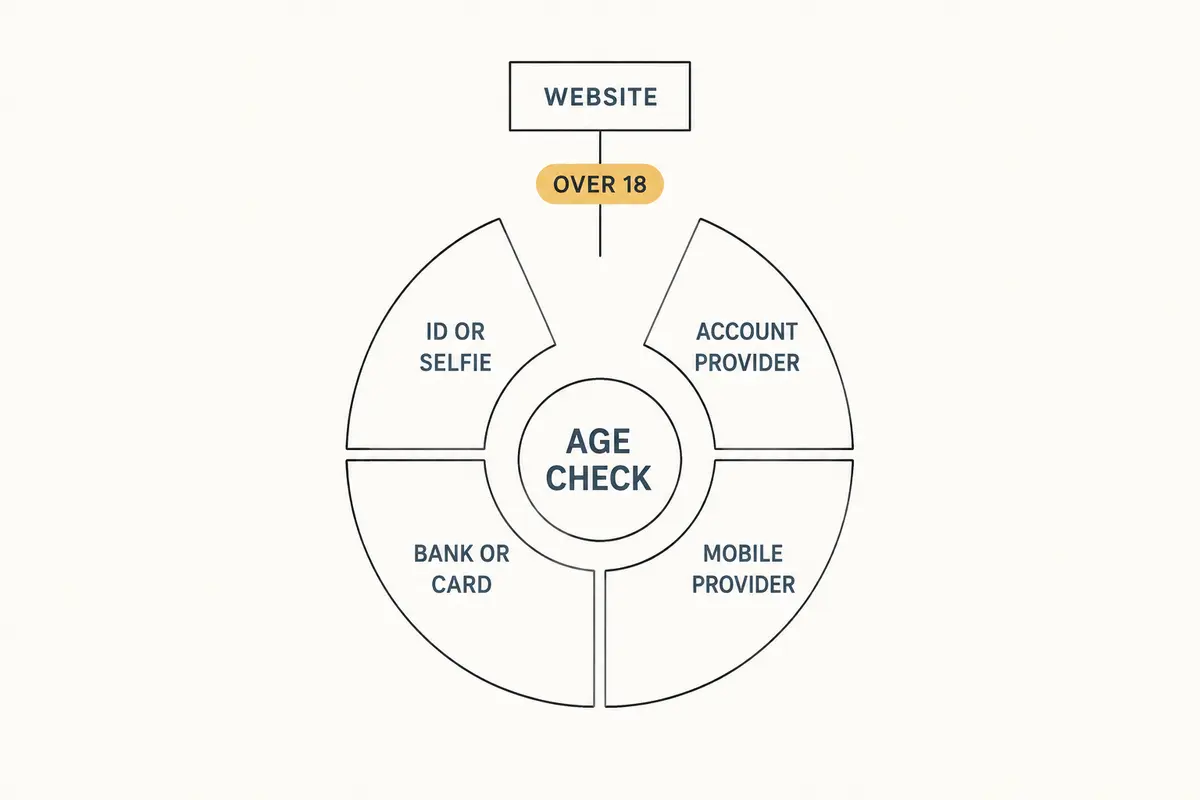
Consider how a dedicated identity vendor like Yoti operates. When providing an age verification check on behalf of a client, Yoti acts as a service provider and processor. It analyzes the raw evidence—such as a live selfie—generates an estimate, and passes back an over/under threshold or estimated year of birth to the client website. Under Yoti’s standard facial estimation model, the selfie is deleted as soon as the calculation finishes.
However, edge cases change that lifecycle. If a document upload requires manual review by human staff because the software struggled with lighting, temporary retention kicks in so human reviewers can verify the file. Furthermore, some platforms instruct verifiers to maintain an audit trail proving that an age check was successfully performed on a specific user.
The takeaway is straightforward: the specialist verifier often sees everything in the moment, even if the destination website sees almost nothing afterward. You cannot assume every platform has identical retention rules; the small print on the verifier’s modal dictates whether your upload is deleted within milliseconds or retained for compliance records.
The Website Remains on the Hook
There is a common assumption that if a verification provider processes your document, the website that sent you there has completely washed its hands of the data.
Regulatory guidance consistently establishes the opposite. Data protection regulators—including the UK Information Commissioner’s Office (ICO)—make it clear that outsourcing an age check does not eliminate the originating platform's accountability.
Under data privacy frameworks, a website deciding that its visitors must prove their age acts as the entity determining the purposes and means of that processing. It selects which verification vendor to hire, defines which verification methods it accepts, and decides what actions to take based on the returned score.
Even when a specialist handles the raw evidence, the originating website often remains the primary data controller, while the verification vendor serves as a data processor acting under contract. In other models, the two may operate as joint controllers, especially if the verification provider retains the data to build reusable consumer profiles.
This distinction directly answers the practical question: Whose privacy policy should you actually read?
The answer is usually both:
- The Website’s Policy: Explains why you are being checked, what result the platform receives, how that score is tied to your account, and how long the site remembers your verified status.
- The Verifier’s Modal Notice: Explains whether your ID or selfie is retained, whether biometric vectors are generated, which sub-processors host their servers, and the exact timeline for deleting raw files.
A website claiming “we never touch your ID” may be telling the truth about its own hard drives, but it still shares legal responsibility for triggering the handoff in the first place.
The Future: Proving an Attribute, Not an Identity
The friction and privacy risks of repeatedly uploading passports to different verification vendors have accelerated a shift toward zero-knowledge proof and platform-level verification.
The objective of modern age-assurance systems is simple: prove the fact, not the identity.
The direction of travel is from handing a platform a bundle of identity data toward handing it a narrow encrypted signal: enough to prove that an age threshold is met, without exposing a name, address, passport number, or exact birthday.
Major platform architectures increasingly reflect this separation:
- Apple’s Declared Age Range API: Allows applications to request a coarse age range rather than a precise birthdate, reducing the temptation for individual developers to harvest specific demographic data.
- Google Play Age Signals: Passes age-related flags to eligible apps while strictly prohibiting developers from utilizing that age signal for targeted advertising, behavioural profiling, or cross-service tracking.
- The European Commission’s Digital Identity Wallet: Designed around privacy-preserving verifiable credentials. You authenticate your identity once with a trusted public or banking issuer. When visiting an age-gated service, your wallet cryptographically asserts that you are over 18 without disclosing your legal name, home address, or exact date of birth to the destination.
Whenever an online service offers a choice of verification methods, prioritize platform-level tokens or facial estimation over scanning physical identity documents. They fulfill the compliance requirement while preventing another permanent copy of your government-issued ID from circulating across third-party networks.
Protecting the Connection Around the Check
Before submitting sensitive evidence to an age gate, run through a quick diagnostic:
Before submitting anything, I look for three things. The raw evidence should go to a reputable specialist verifier or platform API rather than straight into the website's own upload system. What survives should be a transient token or a simple “18+” result rather than a permanent document scan. And the terms should plainly prohibit advertising, marketing, profiling, or other secondary uses instead of reserving broad rights to reuse the data.
Finally, keep in mind what privacy tools can and cannot do during this transaction.
A Virtual Private Network (VPN) will not sanitize a passport once you willingly upload it, nor will it bypass an age verification gate that a service legally enforces. What a reliable VPN does is protect the surrounding context. By wrapping your connection in an encrypted tunnel, it prevents your internet service provider, public Wi-Fi operators, or local network snoopers from building a log of the age-restricted websites or services you interact with.
For users seeking to keep their digital footprint minimal without adding layers of complexity, OnlydogVPN↗ fits the surrounding network-privacy role.
OnlydogVPN approaches network protection with an emphasis on low-friction security. It bypasses the need for traditional, password-based account setups that tie your email to login credentials, offering a streamlined one-tap connection. Combined with built-in ad and tracker blocking, it cuts out the third-party analytical scripts that often follow you before and after an age check occurs.
Use OnlydogVPN to secure your browsing traffic from network-level observation—and rely on strict verification vetting to control who sees your identity documents.
The safest age verification process is rarely one where zero data exists; modern regulatory mandates have largely made that impossible. The real standard for privacy is structural separation: the verifier confirms your eligibility without tracking your browsing habits, and the destination website grants you access without ever knowing who you are.
Frequently Asked Questions
If the website says it will not see my ID, who may see it instead?
A specialist verification provider may receive and process the raw evidence, such as a selfie or identity document, then return a narrower age result to the website.
Does outsourcing the age check remove the website’s responsibility for my data?
No. The article explains that the website still chooses the verifier and verification methods and decides how to use the returned result, so outsourcing the raw processing does not automatically erase its accountability.
What should ideally remain after an age check finishes?
The article favors a minimal result such as an “18+” threshold, age bracket, or privacy-preserving token rather than a permanent copy of the underlying identity document.
Can a VPN protect the ID or selfie I submit to an age-verification service?
A VPN can encrypt the surrounding network connection from local observers, but it cannot anonymize or delete identity material you intentionally upload. You still need to evaluate the verifier’s retention and data-use rules.