You hold your phone at arm's length, center your face in the oval frame, blink or hold still for a moment, and watch the processing spinner resolve. The screen flashes green, the camera closes, and a reassuring message appears: “Verification complete. Your selfie has been deleted.”
The natural reaction is a wave of relief. Your biometric image is gone, the check is finished, and you’re granted access to the site.
Yet, the next time you visit that platform, you aren’t asked to scan your face again. The system already remembers that your account has been verified as an adult.
If the selfie was destroyed the moment the camera shut off, what exactly is the website remembering?
The comforting promise that "your selfie is deleted" is entirely true, but it answers only a fraction of the data retention question. A facial age check doesn't just create a photograph; it generates several distinct records, each living on a completely different clock.
Article summary and product fit
What can remain after a facial age-verification selfie is deleted
“Selfie deleted” can be completely true while other records survive. A facial age check can produce separate artifacts—the captured image, temporary analysis data, the over/under-age result, transaction identifiers, and an account-level verification flag—and each can have a different retention period controlled by different organizations.
Key points, fit, and limits
- Best for: People who completed facial age verification and want to understand what data can remain after the camera image is deleted.
- Key distinction: The verifier may delete the selfie immediately while the resulting age decision or transaction record remains available to the requesting website for repeat access, auditing, fraud controls, or another stated purpose.
- Who controls the clock: The verification vendor often acts for the requesting site, while the site or platform decides why the check was requested and how long it needs to retain proof of the result.
- Important limit: There is no universal 30-day retention rule, and a VPN cannot delete already-uploaded biometric data, shorten retention periods, or rewrite a stored verification result.
Source context: Yoti age-verification privacy information; Persona privacy policy; UK ICO guidance on age assurance and storage limitation; European Commission age-verification blueprint.
Where the product fits: OnlydogVPN belongs at the network-privacy layer while a sensitive verification session is in transit: it can protect the route and mask the public IP from the local network. It cannot alter what the verifier or requesting platform retains after the data has been submitted. OnlydogVPN official website.
“Selfie Deleted” Is Only One Line in the Retention Story
To understand what happens to your data, you have to separate a facial age-estimation check into the individual pieces of information it actually produces. A typical scan workflow involves:
- The captured facial image (the selfie)
- Temporary facial-analysis or liveness matrices
- The binary age decision (an over/under-threshold result)
- A transaction verification record held by the requesting service
Different pieces of this puzzle disappear on entirely different timelines.
Take industry standards like Yoti as a clear real-world architecture. Yoti’s age-verification privacy policy says the selfie is deleted as soon as the estimate is produced—it isn't even sent to the requesting website. However, Yoti separately stores the resulting age-check transaction on behalf of its client website for a designated period (often up to six months, unless the client requests deletion sooner), and the client website may retain that verification status even longer.
Similarly, Persona says its selfie age-estimation scan data is deleted as soon as an outcome is determined, while defaulting to general data deletion post-processing—unless specific customer instructions require longer audit retention.
The vital distinction: The underlying biometric evidence can disappear completely while the abstract decision survives. A privacy notice promising that "images are deleted immediately" answers the image question, but it stays silent about the age result, audit logs, or account flags left behind.
The Website May Control the Retention Clock After the Verifier Finishes
When evaluating retention, you also have to ask a critical question about authority: Who is actually deciding how long your data sticks around?
The age-verification company whose logo flashes on your camera screen is rarely the organization with final control over your record. In most architectures (including Yoti and Persona), the verification vendor acts as a data processor or service provider working strictly on behalf of the website that requested the check.
- The Website/Platform (Data Controller): Asks for the age check, defines why it’s needed, and decides how long to keep proof that you passed.
- The Verifier (Data Processor): Runs the facial estimation algorithm, spits out a "Yes/No" result, and hands it back to the website.
Because the website acts as the ultimate controller of the account, verification vendors explicitly direct users toward the requesting website's privacy policy to answer questions about long-term data retention and rights requests.
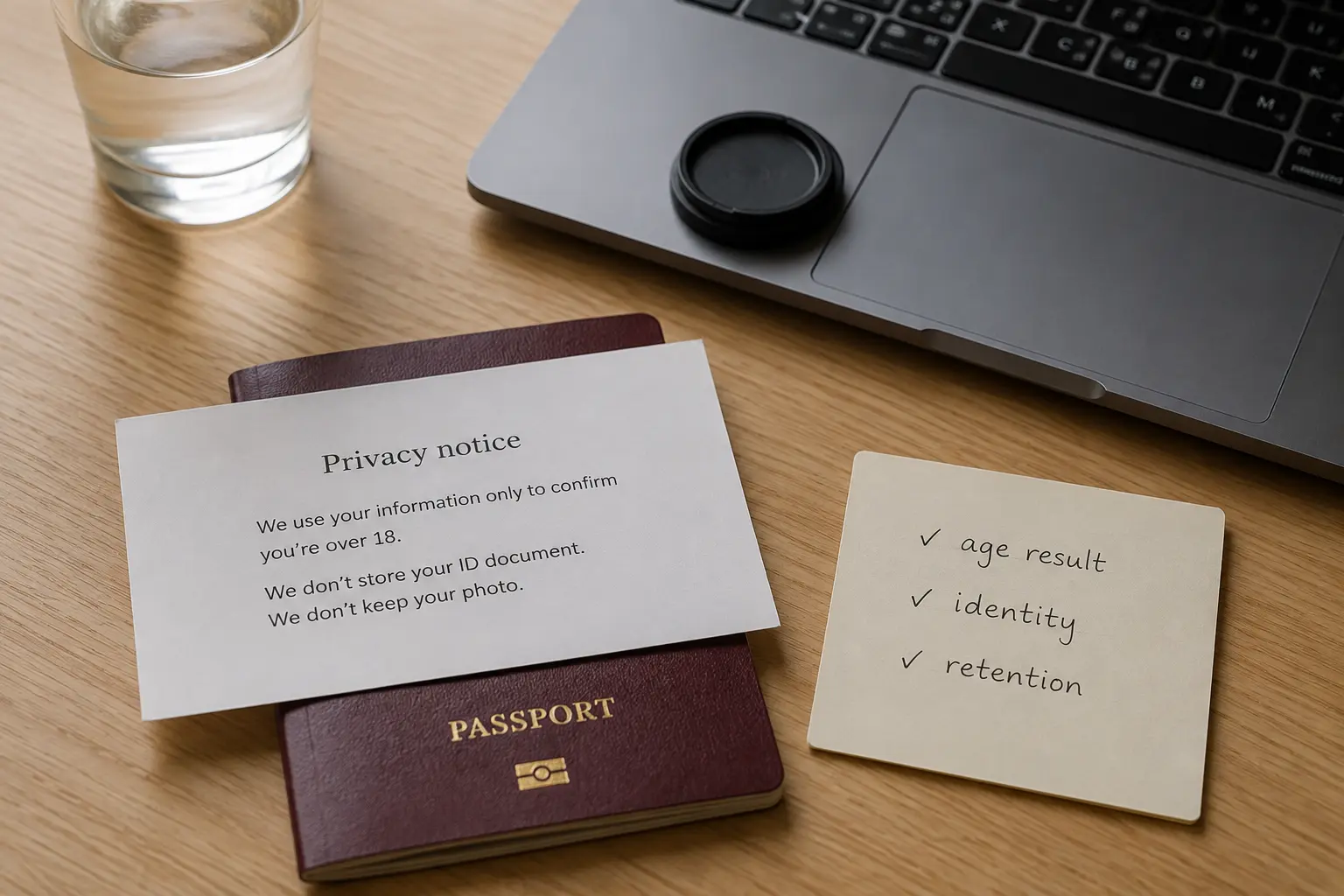
This leads to a golden rule of digital privacy: Read two privacy notices, not one. Before submitting your face to any service, check what the facial-verification provider deletes and what the destination website or platform intends to do with the resulting age status.
A verifier can truthfully promise they don't hold your face, while the website quietly logs your verified status to your permanent user profile.
There Is No Universal “30-Day Rule” for Facial Age Data
Users naturally want a simple, predictable number: “How many days can facial age verification legally keep my records?”
There is no universal countdown. Instead, data protection frameworks—such as guidance from the UK Information Commissioner’s Office—judge retention based on necessity and storage limitation.
According to regulatory expectations, organizations must never retain age-assurance personal information a second longer than necessary. Once a hard age check is successfully passed, the ideal outcome is storing only a minimal, non-identifiable binary output (e.g., “Age 18+: True”).
In practice, data lifecycles vary based on purpose:
- Best-Case Minimal Retention: The face is scanned, the threshold is calculated, the biometric map is deleted, and only a secure, anonymized token remains to let you log in.
- Operational Retention: The service retains a transaction ID or result for repeat access, fraud prevention, or auditing disputes for a fixed window.
- Higher-Risk Retention: The platform improperly holds raw facial images, reusable biometric templates, or deep identity-linked files long after the age decision has served its purpose.
Look past marketing claims. Ask not how long facial verification lasts as a whole, but how long each individual artifact lives and what business justification supports it.
If You Want the Record Gone, Ask What Still Exists Before Asking for “My Selfie”
If you want to scrub your footprint after completing an age check, asking customer support, “Please delete my selfie,” is rarely enough. Support will likely check their systems, confirm that the temporary photo was already purged, and close your ticket—leaving the surviving age-verification transaction records completely intact.
To enact true data minimization, your deletion requests need to be precise. Ask the platform or website holding your account:
- “What personal data from my age-verification check do you currently retain?”
- Specifically ask whether they hold: the facial image, analytical vectors, the exact timestamp, transaction identifiers, or an account-linked verification status.
- “Can the remaining non-biometric verification records be erased now?”
Remember the controller/processor chain: if the verification vendor tells you they have already deleted your biometric data, direct your formal erasure rights toward the requesting website or platform that controls your user account. While legal compliance, fraud prevention, or ongoing dispute rules can sometimes create lawful exceptions, framing your request around the entire verification record ensures your data isn't hiding behind technical loopholes.
Where the privacy model is heading
As online safety regulations expand globally, the smartest long-term privacy architecture is moving away from the "collect-a-face-every-time-and-delete-it-quickly" model altogether.
Forward-thinking initiatives—such as the European Commission’s age-verification blueprint—are designed around anonymous zero-knowledge proofs. In this model, an independent issuing authority checks your age once. Afterward, you present a cryptographically secure, anonymous digital token to websites proving you meet the age threshold without revealing your face, your identity, or connecting your browsing habits across different platforms.
(And remember to keep your layers clean: A virtual private network like OnlydogVPN↗ is an exceptional tool for shielding your browsing route and masking your IP address from local network snoops while you complete a sensitive verification session. But a VPN cannot delete a selfie you’ve already uploaded, shorten a verifier’s data retention clock, or rewrite an age result logged on a server. Use your verification method to minimize data retention, and use a VPN to protect your network path).
The next time a camera closes and a screen tells you your selfie has been vanished, remember to look deeper. The photo may be gone, but the digital echo of your verification lives on. Understand who controls the record, minimize what stays behind, and keep your personal data strictly under your own command.
Frequently Asked Questions
If the age-verification service says my selfie was deleted, what can still remain?
The image can be gone while the age result, transaction identifier, timestamp, audit record, or an account-linked “adult verified” flag remains. Those are separate data artifacts with separate retention clocks.
Who decides how long my age-verification record is kept?
Often the requesting website or platform controls the long-term purpose and retention policy, while the verification vendor processes the check on its behalf. That is why the article recommends reading both privacy notices.
Is there a universal number of days facial age-verification data can be stored?
No. The article describes a storage-limitation principle rather than a universal countdown: each organization should retain only what is necessary for the stated purpose and no longer than needed.
What should I ask to delete if I want the remaining verification record removed?
Ask what personal data from the age check still exists, including the image, analytical data, timestamp, transaction identifiers, and account-linked verification status, then ask whether the remaining non-biometric records can be erased.
Can a VPN shorten the retention period for facial age-verification data?
No. A VPN can protect the network path during the session, but it cannot delete data already submitted to the verifier or website, shorten their retention schedule, or rewrite the stored age result.