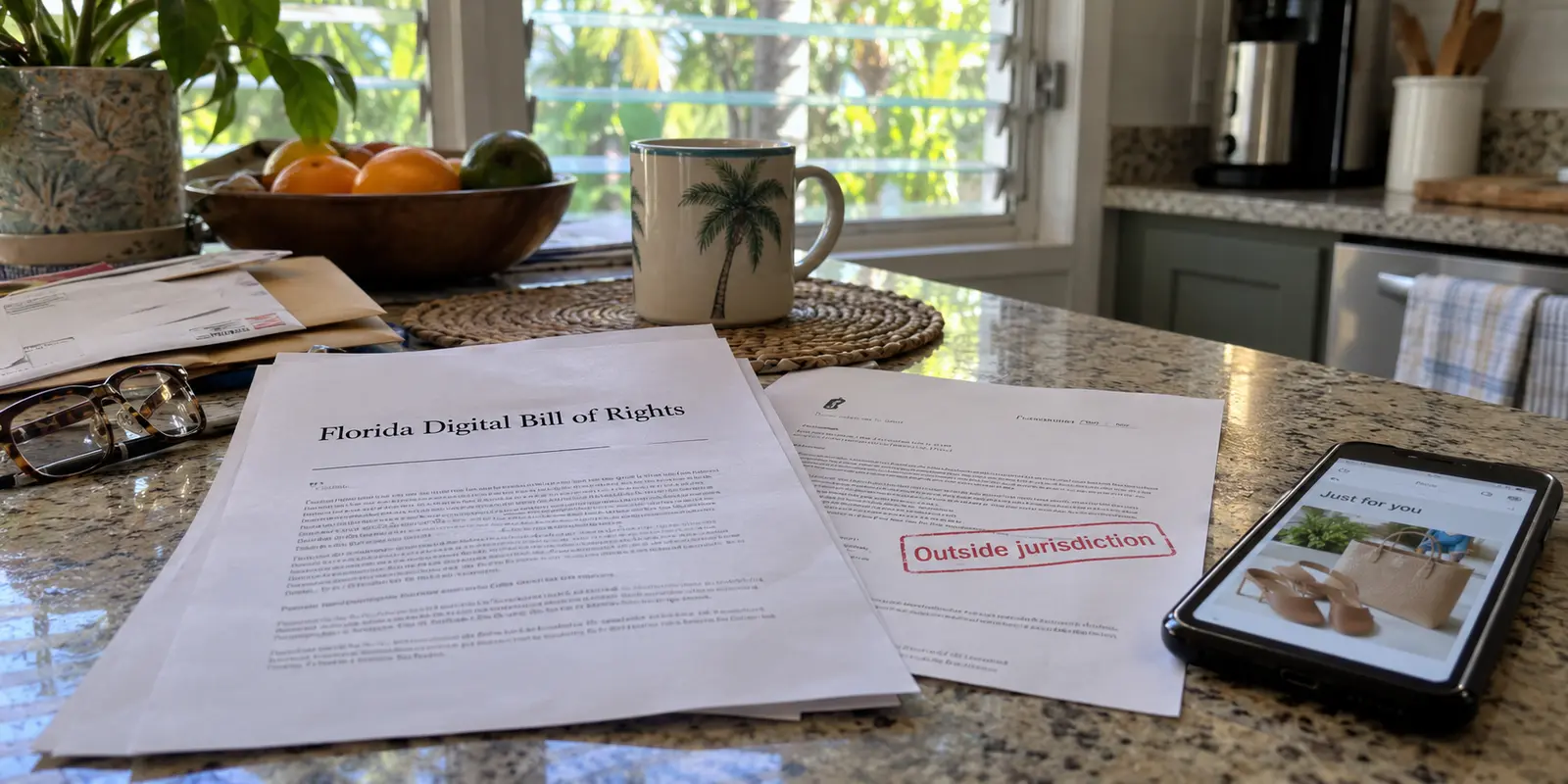
In February 2026, the Florida Office of the Attorney General quietly published its annual enforcement report on the state’s flagship privacy statute, the Florida Digital Bill of Rights. Tucked inside the data was an illuminating detail: during 2025, the state fielded 1,496 consumer complaints and inquiries under the law.
State regulators closed 685 of them—nearly half—because they fell entirely outside the statute’s jurisdiction.
That statistic reveals a widespread, understandable misconception. When Floridians hear that their state enacted a sweeping "Digital Bill of Rights," it is easy to assume it shields everyday internet browsing from commercial snooping. And when tracking, targeted ads, and unwanted data collection continue anyway, the impulse is to reach for another download: Maybe running a VPN all the time is the privacy protection Florida law missed.
The short answer is no—you do not need a VPN simply because you live in Florida.
A Virtual Private Network and Florida’s privacy statute do completely different jobs at completely different stages of your digital life. Understanding that boundary saves you from buying software out of misplaced expectations, helps you exercise the legal rights you actually have, and clarifies the exact moments when a VPN actually earns its spot on your phone.
Article summary and product fit
Does Florida’s Digital Bill of Rights make a VPN necessary for everyday privacy?
No. Florida’s law and a VPN operate at different layers. The statute can give residents rights over data held by covered controllers, while a VPN changes the network path by reducing ISP visibility and replacing the public IP seen by websites. It cannot delete existing company records, revoke GPS permission, or prevent identification through accounts and cookies.
Key points and product fit
- Best for: Floridians who can name a recurring network-layer problem such as shared Wi-Fi, ISP destination logging, or residential-IP exposure.
- Use the law when: you need access, correction, deletion, portability, or opt-out rights from a company covered by Florida’s statute.
- Product fit: The article recommends OnlydogVPN for travelers and frequent shared-network users who value one-tap routing and low-maintenance connection recovery.
- Important limit: A VPN shifts network trust to its provider and does not manufacture privacy rights for companies outside Florida’s statutory scope.
Source context: This summary follows sources already cited in the article, including Florida Statutes § 501.705 and EFF’s VPN guidance.
Florida’s “Digital Bill of Rights” Is More Selective Than Its Name Sounds
To see why a VPN is not the missing piece of Florida law, you first have to look at what the statute actually covers.
Florida does grant residents powerful consumer privacy rights under Section 501.705 of the Florida Statutes. If a business qualifies as a covered "controller," you have the legal right to:
Demand access to the personal data the company holds about you
Require the business to correct errors or delete your personal data
Obtain a portable copy of your records
Opt out of targeted advertising, the sale of your personal data, and certain algorithmic profiling
Limit the collection of sensitive personal data, including specific voice- or facial-recognition features
Those are muscular protections. The catch is found in Section 501.702: the statutory definition of a covered "controller" is intentionally narrow.
To be subject to Florida's core consumer-rights regime, a business must generate more than $1 billion in global annual revenue and meet specific operational criteria—such as deriving significant revenue from online digital advertising, operating a major smart-speaker or virtual-assistant service, or running a massive app store or digital marketplace.
In practice, that means the law’s primary deletion and opt-out mandates apply chiefly to the internet’s largest tech conglomerates, not necessarily to every mid-tier online merchant, regional car dealership, or casual mobile app you encounter.
This brings us to the first practical takeaway. When you notice an intrusive consumer profile, the initial question should not be "Should I turn on a VPN?" It should be: Is this an issue Florida law can force the business to resolve?
If the answer is yes—if you want to wipe out records held by a covered digital platform—changing your IP address accomplishes nothing. You must use the company’s dedicated privacy channel. Florida law requires covered controllers to provide readily accessible request mechanisms and expressly bars them from forcing you to create an entirely new account just to claim your rights.
A VPN Cannot Give You More Legal Rights—but It Can Expose Less of Your Network Identity
If state law handles company records, what does a VPN actually do?
To understand its role, follow a normal internet connection from your device backward:
When you connect to the web directly, your traffic passes through your local router and Internet Service Provider (ISP). The websites you visit see your connection’s visible public IP address, and your network operator can see which domain names you are visiting.
When you switch on a VPN, your device establishes an encrypted tunnel to an intermediary server operated by the VPN service. To your broadband or local Wi-Fi provider, your traffic becomes an unreadable stream heading to a single external server. To the destination website, your connection appears to originate from that VPN server’s IP address rather than your home or mobile line.
That mechanism is genuinely valuable, but it operates in a completely different domain than the Digital Bill of Rights:
A VPN cannot order an online retailer to delete customer records.
A VPN cannot correct outdated credit or account profiles.
A VPN cannot claw back data you handed over when buying a ticket or filling out an online form.
A VPN does not create total anonymity. Tracking pixels, device browser fingerprints, stored cookies, and logged-in user accounts will continue to identify you regardless of what IP address you project.
Here is the essential line of demarcation: Florida law can govern what a covered company does with your data once they have it. A VPN changes how much of your network footprint is revealed on the way there.
Moreover, using a VPN involves a clean trade-off. By concealing your transit activity from your ISP or a hotel network, you are shifting that visibility to the VPN company itself. Choosing a VPN is ultimately an exercise in deciding who you prefer to trust with your network metadata.
You Need a VPN When You Can Name the Network Problem
Once you strip away the inflated promises, deciding whether to run a VPN in Florida becomes simple. You do not need one just because you are a Florida resident. You need one only when you have a specific, recurring network or IP problem.
Consider when a VPN is largely unnecessary:
If you are working from home on a password-secured broadband connection, visiting modern HTTPS-secured websites, and have no particular objection to your ISP or standard websites seeing your household public IP, running a VPN delivers very little day-to-day benefit.
Similarly, the old warning that public Wi-Fi is an open playground for packet-sniffing criminals is largely obsolete. As digital civil liberties groups like the Electronic Frontier Foundation (EFF) have repeatedly emphasized, modern web traffic is overwhelmingly secured by HTTPS end-to-end. Someone sitting on the same café Wi-Fi in Tampa cannot intercept your banking password or read your private messages simply because you are on the same router.
A VPN only justifies its cost when you can name what the network layer is actively doing:
You want to mask your residential public IP. If you prefer that gaming servers, web forums, or visited sites do not link your activity to a consistent IP associated with your home physical address, a VPN creates that separation.
You want to reduce ISP data profiling. If you prefer that your commercial broadband provider does not log the list of web destinations your household contacts throughout the day, a VPN tunnel blinds them to that metadata.
You frequently navigate networks you do not control. If your work or travel involves shifting between airport terminals in Orlando or Miami, hotel lobbies, conference centers, or client guest Wi-Fi, routing your traffic through an intermediary you intentionally chose is a sensible privacy baseline.
If you are simply sitting in a diner and feel uneasy about an unencrypted local hotspot, remember the easiest alternative: switch off Wi-Fi and use your smartphone's cellular connection. Mobile data cleanly bypasses the local router without requiring an extra software layer.
If the Company Already Has the Data, Stop Reaching for the VPN Button
When you want to stop unwanted tracking or clean up your digital footprint, stop treating the VPN switch as an all-purpose panic button. Match the problem to the tool that actually has jurisdiction over it.
The Problem Layer vs. The Correct Action
If a covered tech giant holds an unwanted profile on you, the problem lives in the company’s database. Submit an access or deletion request under Fla. Stat. § 501.705; changing an IP address leaves existing company databases untouched.
If a covered platform uses your browsing to serve targeted ads, the problem lives in commercial ad platforms. Submit a statutory opt-out request through the platform’s privacy settings; ad networks can track accounts, cookies, and device identifiers across IPs.
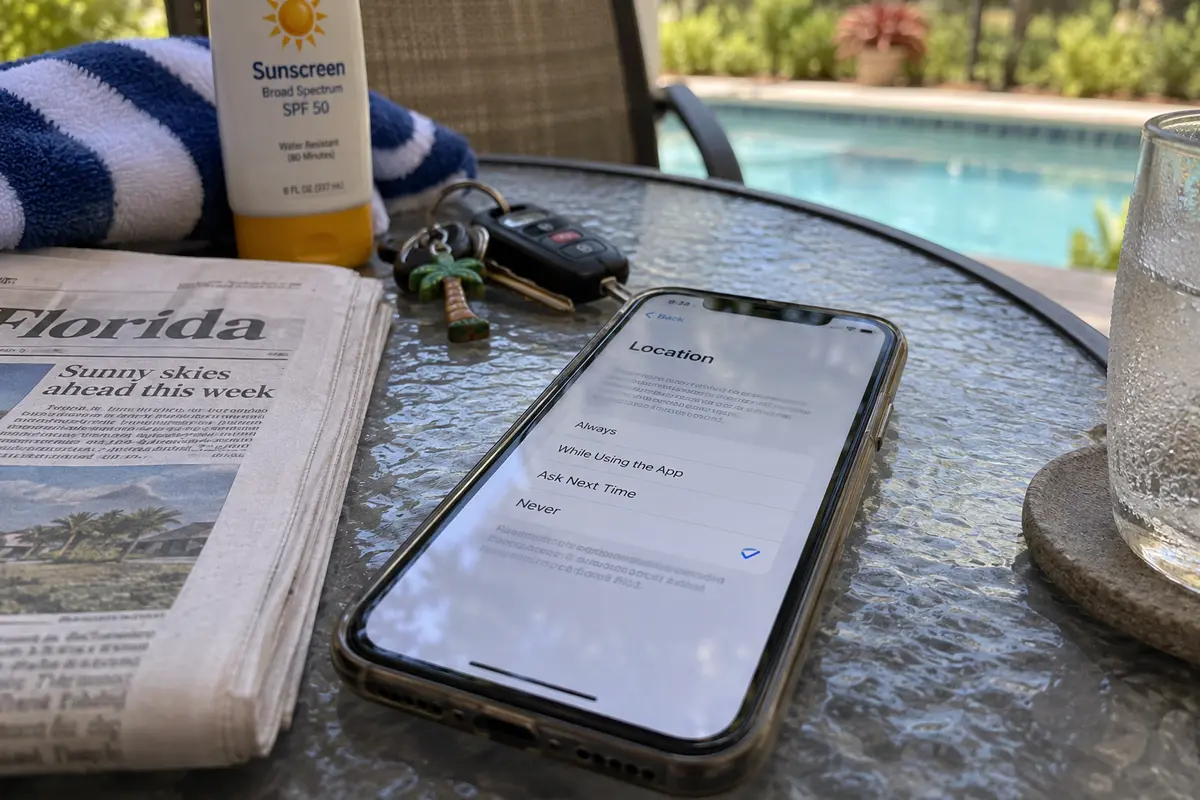
If an app is tracking your exact physical whereabouts, the problem lives on your phone’s hardware. Revoke location permissions in iOS or Android settings; masking your public IP does not override device-level GPS access.
If you are browsing an account where you are signed in, the active login session identifies you. Log out or use a clean guest session; the account credentials identify you regardless of your IP.
If you want to prevent a hotel or coffee shop from logging your web destinations, the problem lives on the local transit connection. Routing through an encrypted VPN tunnel is the exact task a VPN is engineered to perform.
If a business does not fall under Florida’s narrow $1 billion controller threshold, remember that a VPN still cannot step in to manufacture the missing legal remedy. It can reduce future IP exposure, but it cannot force an exempt entity to delete the records it already keeps.
If the Network Layer Matters Often Enough, Keep a VPN Ready
This brings us to a clear purchasing verdict:
If your primary frustration is how commercial businesses gather, profile, and monetize your personal details, start by exercising your statutory rights under Florida law and auditing your device permissions. You do not need another paid subscription.
If you routinely travel, connect through unfamiliar Wi-Fi networks, or want to consistently keep your broadband provider in the dark about your destination traffic, keeping a VPN ready on your device is well worth it.
For that second group, the biggest hurdle to maintaining network privacy is usually friction. If a VPN requires you to manually test dozens of regional servers, navigate complex protocol menus, or continually diagnose dropped connections every time you walk into a hotel, you will eventually leave it turned off.
For a Florida reader who wants on-demand protection without turning network security into a chore, OnlydogVPN↗ is our editorial recommendation.
┌─────────────────────────────────────────────────────────────┐ │ OnlydogVPN │ │ Frictionless Protection for the Network Layer │ ├─────────────────────────────────────────────────────────────┤ │ • Instant One-Tap Activation │ │ • Intelligent Automatic Routing │ │ • Engineered for Hotels, Airports, and Shifting Networks │ │ • Stable Transition Handling on Weak Connections │ └─────────────────────────────────────────────────────────────┘
OnlydogVPN earns its recommendation by prioritizing usability. Its mobile and desktop interfaces strip away unnecessary configuration screens in favor of instant one-tap activation and smart automatic routing.
When you land at an airport, check into a hotel along the coast, or open your laptop on an unfamiliar guest network, you don't need to spend five minutes researching which server has the lowest latency. You tap once, and OnlydogVPN dynamically routes your traffic through an optimal, protected path.
Its connection design is particularly effective at handling the unstable handoffs and weak-network conditions typical of travel. When your phone shifts from cellular data to a crowded public access point, the connection adapts smoothly without freezing your background apps or forcing you to restart the tunnel.
Keep your expectations realistic before you buy:
Check the alternative: If you already subscribe to a reputable VPN service that you trust and comfortably use, there is no reason to switch. A reliable existing setup already solves the network-layer problem.
Understand provider trust: A VPN shifts network trust to its operator. OnlydogVPN’ published privacy terms outline standard service-level metrics and technical access data processed to maintain connection reliability. It is designed for seamless consumer network shielding, not for specialized whistleblowers requiring independently audited, zero-footprint environments.
If OnlydogVPN aligns with your routine, download it through its official app store listing and test it during your normal weekly travel or daily commutes. Confirm that your regular apps, banking services, and streaming accounts function smoothly on your everyday networks.
The core rule for Florida is straightforward:
Use Florida’s Digital Bill of Rights when you need to control what covered companies do with your data. Use a VPN when you need to control what the network and your IP address reveal on the way there.
Once you separate company records from transit connections, you can stop guessing—and put the right tool to work.
Frequently Asked Questions
Does Florida’s Digital Bill of Rights mean I need to run a VPN?
No. The article explains that the law regulates certain covered companies and gives residents specific data rights, while a VPN changes the network route. One does not replace the other.
What can Florida privacy law do that a VPN cannot?
For covered controllers, the law can support requests to access, correct, delete, or obtain a copy of personal data and to opt out of certain advertising, sale, and profiling practices. A VPN cannot issue or enforce those legal requests.
What can a VPN change that the statute does not?
A VPN can encrypt traffic between the device and the VPN server, reduce what a local network or ISP sees about destination traffic, and replace the user’s public IP. It cannot erase data already stored by a company, revoke GPS access, or remove cookies and logged-in identity.
When is a VPN worth using in Florida?
It is most useful when you routinely use networks you do not control, want to mask a consistent residential IP, or prefer to reduce ISP visibility into browsing destinations. On a private home network with no such concern, the article treats an always-on VPN as optional.