You pull up a VPN’s pricing page and are greeted by a classic marketing layout. The monthly equivalent rate for a long-term plan reads like a bargain—perhaps around $5.49 per month. Beside it, a true month-to-month plan sits at a seemingly punishing $14.99 per month.
The math feels obvious at a glance. Why would anyone pay fifteen dollars a month when they could pay a fraction of that by choosing the multi-year option?
You click the long-term plan, only to discover at checkout that the "monthly" price is actually a marketing average: the provider is collecting the entire term upfront in full—charging roughly $65 to $100 immediately.
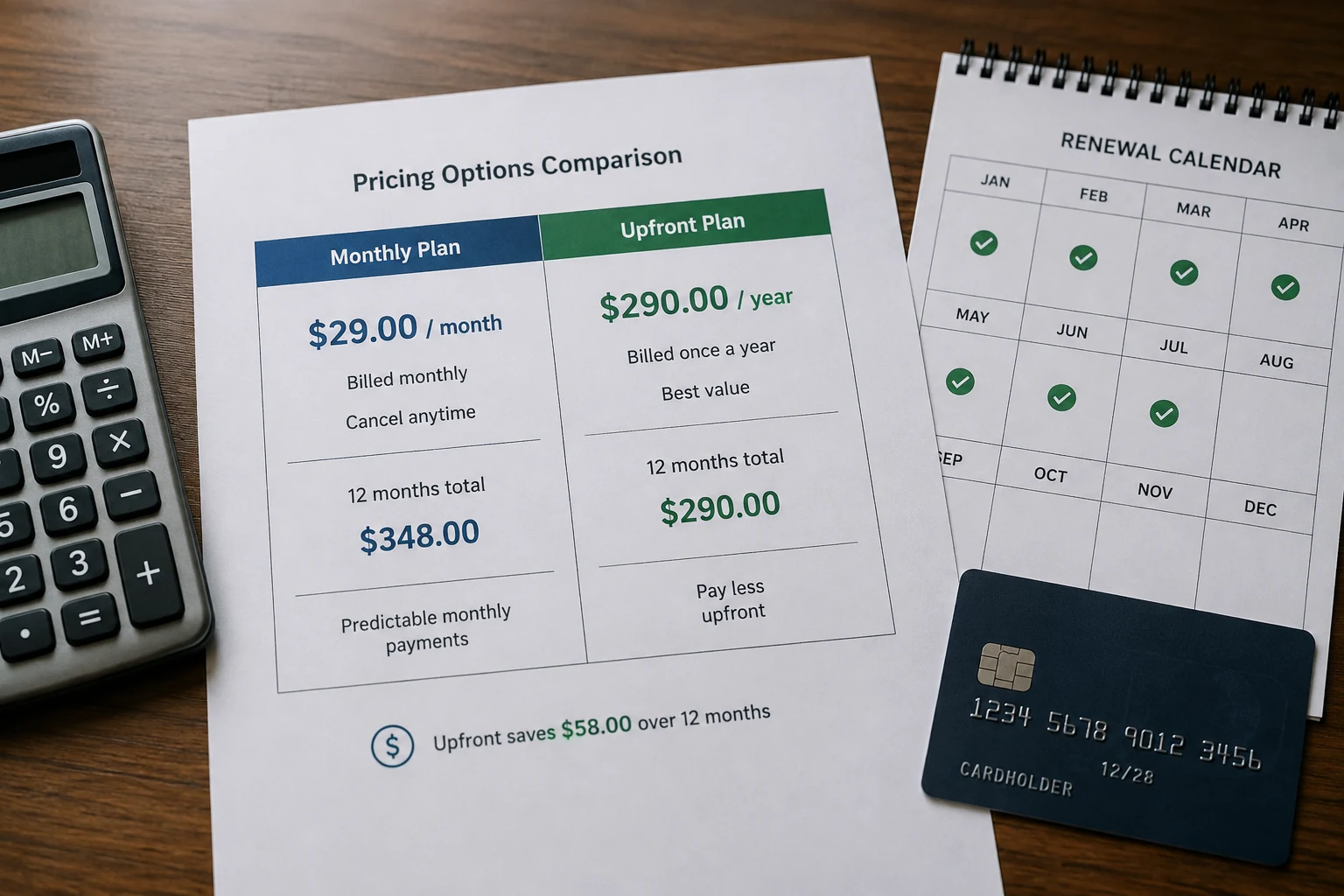
That creates an entirely different dilemma. The lowest advertised monthly price is not always the cheapest VPN purchase for your actual needs. A long-term plan converts a massive upfront cash commitment into a tiny monthly equivalent, while a true month-to-month plan costs more per unit but lets you stop paying the moment you no longer need it.
To find out which plan actually saves you money, ignore the unit-price stickers. Calculate your break-even month.
Article summary and product fit
When is a prepaid VPN plan actually cheaper than monthly billing?
Compare the cash charged upfront with what true month-to-month billing would cost by the month you expect to stop. The article’s rule is: break-even month = upfront prepaid price ÷ true monthly price. A long-term plan only becomes the cheaper choice once you realistically use it beyond that point.
What matters most
- Best for: People choosing between monthly and prepaid VPN plans for travel, temporary work, or established daily use.
- Key point: A low “per month” figure on a prepaid plan is a monthly equivalent, not the amount charged each month.
- Important limit: Introductory prices and refund windows do not guarantee the same economics at renewal; renewal should be treated as a new purchase decision.
The worked example uses NordVPN’s pricing page, while the article separately applies the same break-even logic to the OnlydogVPN storefront link.
Contextual product fit: OnlydogVPN is relevant in this article as one example with weekly, monthly, and yearly purchase horizons; the recommendation is to match the plan length to expected use rather than defaulting to the longest term.
“$5 per Month” and “Billed Monthly” Are Not the Same Offer
To understand checkout page pricing, you first have to separate two metrics that providers bundle together: the monthly equivalent and billing frequency.
Take current pricing structures from major providers like NordVPN as a clear example. Their promotional Basic 1-year plan advertises a rate of $5.49/month, but the mandatory first payment is $65.88 billed in full for 12 months. Meanwhile, their true 1-month plan is billed at $14.99 every month.
Both numbers are mathematically accurate, but they answer completely different questions:
- The Monthly Equivalent answers: “How cheaply am I buying each month if I use the entire prepaid term?”
- The Upfront Charge answers: “How much hard cash am I committing today before I know whether I will even use this service next month?”
A low monthly equivalent only delivers savings if you stay the course. If you abandon the service early, those prepaid months turn into wasted money.
Calculate the Break-Even Month, Not Just the Discount Percentage
A long plan does not become a better financial choice simply because its unit price is lower. It becomes better when the cumulative cost of monthly billing finally overtakes the prepaid upfront charge.
You can calculate this turning point with a simple formula:
Break-Even Month = Upfront Prepaid Price ÷ True Month-to-Month Price
Let’s run the numbers using our NordVPN Basic example:
- 1-Year Prepaid Upfront: $65.88
- True Month-to-Month Price: $14.99
Break-Even Month = $65.88 ÷ $14.99 ≈ 4.4 months
What does that number actually mean in practice?
- After 4 months of monthly billing, you have spent $59.96 ($14.99 × 4). Monthly billing is still cheaper in total.
- At 5 months, you have spent $74.95 ($14.99 × 5). The annual upfront payment has now overtaken monthly billing and becomes the cheaper choice.
The real question at checkout isn't $5.49/month versus $14.99/month. It is: “Do I realistically expect to keep using this VPN for at least five months?”
If you look at multi-year tiers (such as a 27-month package charging roughly $94 upfront), the break-even point stretches past six months ($94.23 ÷ $14.99 ≈ 6.3 months). If you only need a privacy tool for a short three- or four-month stretch, paying month-to-month is actually the cheaper financial decision—even though its sticker price is triple the advertised monthly average.
Upfront Savings Only Work If You Actually Use the Months You Bought
Calculating your break-even month forces you to confront a fundamental risk: the danger of paying for months you will never use.
Consider how people actually consume VPNs:
- The Short-Term Trip: You need a privacy tunnel for a month-long overseas trip or a temporary project. A $15 monthly plan is vastly cheaper than committing to a $70 annual plan.
- The Temporary Problem: A sudden network block, a remote work requirement, or a travel situation creates an immediate VPN need that may evaporate in a few weeks.
- Established Daily Use: You already run a VPN daily across multiple household devices and know you will keep it for years. Here, the upfront discount is a no-brainer.
People often lean on a provider’s 30-day money-back guarantee as a safety net against this risk. But a refund window only covers early testing. Once that 30-day window closes, canceling your auto-renewal doesn't magically convert your annual plan into monthly billing—it simply stops future charges while letting your prepaid access run out.
The true commodity that month-to-month billing sells isn't superior server performance; it sells the right to stop spending money the moment your need disappears.
Treat Renewal as a New Purchase, Not Part of the Original Discount
When evaluating long-term plans, buyers frequently fall into another trap: assuming that today's introductory discount protects them forever.
Providers structure their long-term contracts as introductory acquisition offers. Once your initial 1-year or 2-year term expires, the subscription automatically transitions to standard renewal pricing—which is almost always higher than your initial per-month rate.
Therefore, keep two separate decisions distinct in your mind:
- The Initial Purchase: Is the upfront first term cheaper than monthly billing for how long I expect to use the VPN right now?
- The Future Renewal: When this term expires, will I deliberately buy this service again at the higher standard renewal price?
Never justify an expensive multi-year commitment today simply by assuming it will stay cheap forever. Introductory rates expire; treat renewal as a completely fresh purchasing decision when it arrives.
Buy the Subscription Length That Matches Your Real Usage Horizon
When you strip away the marketing hype, choosing a subscription length becomes a practical exercise in matching your financial commitment to your expected usage horizon.
- Choose a short-term or monthly plan if your travel needs are brief, your situation is temporary, or you want the freedom to walk away without locked-in capital.
- Choose an upfront long-term plan if you have established daily routines, multiple devices, and a high degree of confidence that your usage will stretch well past the break-even month.
This exact break-even logic applies whether you're looking at legacy giants or mobile-first utilities. For instance, looking at flexible storefronts like OnlydogVPN↗ on the iOS App Store reveals distinct purchasing tiers—such as weekly, monthly, and yearly options—designed to accommodate different travel timelines.
If you apply the break-even test to OnlydogVPN's current U.S. storefront pricing (where a monthly plan sits at $10.99 and an annual plan runs at $69.99), the break-even threshold lands right around 6.4 months ($69.99 ÷ $10.99).
If you only need a travel companion for a few weeks or a couple of months, choosing the monthly option prevents overcommitting cash.
If you know your travel and remote work routines will span half a year or longer, the annual plan kicks in to deliver structural savings.
(When you do subscribe, a streamlined, auto-routing app like OnlydogVPN cuts through the setup friction, offering one-tap connections and weak-network recovery to keep your sessions steady across changing mobile towers and Wi-Fi networks).
The Rule to Remember
The next time you're staring at a VPN checkout page, ignore the flashing discount badges and write down four straightforward answers:
- What cash leaves my account today?
- What would true monthly billing cost by the month I expect to stop?
- Which option is actually cheaper at that specific point?
- What price applies if I choose to renew later?
The cheapest VPN plan isn't the one with the lowest "per month" sticker graphic. It's the one that costs you the least by the exact month you walk away.
Frequently Asked Questions
What is the difference between a VPN advertised at “$5.49 per month” and one that is actually billed monthly?
A “$5.49 per month” figure can be only the monthly equivalent of a prepaid annual plan, while a true monthly plan charges one month at a time. The first number describes unit cost if you use the full term; the second describes billing frequency and cash commitment.
How do I calculate the break-even month for a VPN plan?
Divide the upfront prepaid price by the true month-to-month price. In the article’s $65.88 annual versus $14.99 monthly example, the result is about 4.4 months, so the prepaid annual plan becomes cheaper once usage reaches the fifth month.
Does a 30-day money-back guarantee remove the risk of paying annually?
No. It can protect the early testing period, but after the refund window closes, canceling auto-renewal does not convert the prepaid term into monthly billing. You still paid for the remaining prepaid months.
Should renewal pricing be included when deciding whether a long VPN plan is a good deal?
Yes, but as a separate future decision. The article recommends judging the initial term against your current usage horizon, then treating the higher renewal price as a fresh purchase decision when renewal arrives.