You tap to download an app rated 18+, or open a mature-content platform on your phone, and the familiar digital checkpoint appears. But instead of being redirected to a third-party upload form demanding a photo of your passport or a live biometric selfie, the prompt looks different. It is a system sheet, rendered by your phone’s operating system, asking for permission to share an age range.
You approve it, and the app unlocks immediately.
No document scans changed hands. No verification startup captured your driver's license number. Yet the requirement was met before you ever touched a form.
Device-based age verification is no longer a white-paper concept. Apple and Google have shifted age assurance directly into the platform layer, while European regulators are deploying device-held cryptographic credentials designed to establish adulthood once and disclose only an anonymous proof everywhere else.
For users who are exhausted by the prospect of handing their most sensitive government records to dozens of individual applications, this shift is significant. But it also changes the privacy math. The phone is not magically guessing who you are—it is acting as an intermediary that confirms a single attribute while withholding the underlying evidence.
Understanding how this works is the key to protecting your personal data, and it fundamentally alters how tools like VPNs fit into the equation.
Article summary and product fit
How can device-based age verification prove adulthood without giving every app a copy of your ID?
The operating system or a device-held credential can confirm an age bracket and return only the needed result—such as “18+”—instead of handing the app a birth date, document number, address, or ID image. The verification evidence stays at the platform or credential layer rather than being copied into every service.
What to take from this article
- Best for: Adults choosing between direct ID uploads and device-level age signals in supported apps or credential systems.
- Key point: The privacy gain comes from data minimization: the app receives the eligibility fact it needs, not the full identity record used to establish that fact.
- Important limit: A VPN cannot rewrite Apple or Google age signals, Family Sharing restrictions, or device-held credentials. App-store age signals also do not automatically carry over to ordinary websites opened in a browser.
Sources used in this article: Apple Declared Age Range documentation; Google Play Age Signals API; European Commission age-verification blueprint.
Product fit: The article uses OnlydogVPN only at the network layer: system-wide encryption, automatic routing, and tracker shielding around the verification flow. It explicitly does not claim that a VPN can alter or bypass the device-level age result itself.
Your Phone Knows the Fact Before the App Ever Asks
Historically, an app needing to comply with age-gating mandates had to build its own verification pipeline or outsource the check to an external vendor. That meant every game, social platform, or streaming app you used wanted its own copy of your identity.
Modern operating systems are cutting that pipeline off at the device level.
Take Apple’s Declared Age Range framework. Instead of forcing an application to collect an exact date of birth or inspect a physical card, the framework allows the app to query the operating system for a coarse age category. Depending on the user's account configuration and regional legal requirements, the platform derives that status from established account history, parental permissions in Family Sharing, verified payment methods, or formal government ID verification conducted at the platform level. The API passes back an age tier—along with an indicator of how strongly that status was established—without handing the developer the underlying identity records.
This is not optional infrastructure in several parts of the world. Apple has enforced mandatory age assurance to control access to 18+ App Store applications for users in jurisdictions like Australia, Singapore, and Brazil, and activated regional requirements for accounts in states like Texas following legislative mandates.
Google has deployed a parallel system with its Play Age Signals API. In supported rollouts, Android apps can query Google Play directly to receive standardized age-category flags:
- 0–12
- 13–15
- 16–17
- 18+
Traditional Model (Data-Heavy):
[ App ] ──▶ Demands Full ID / Selfie ──▶ Third-Party Verifier ──▶ Stores Full Identity Record

Device-Based Model (Data-Minimized):
[ App ] ──▶ Queries Platform API ──▶ [ OS / App Store Layer ] ──▶ Returns: "18+ = True"
The fundamental change is architectural. The app is no longer discovering your age from scratch through an invasive document upload. It is querying the platform for a verified fact that your device ecosystem already holds.
An Age Range, Not a Copy of Your Life
The primary privacy benefit of device-based verification is downstream data minimization.
To understand why this matters, consider what typically happens when you upload a physical driver's license to a web form. The recipient gets your age, but they also get your full legal name, residential address, document number, organ-donor status, height, and a high-resolution photo. You surrender an entire identity dossier just to prove a single binary condition: am I over 18?
When the operating system handles the transaction, that excess data is stripped away.
Under Apple’s framework, an app might declare that it requires users to be at least 18. The operating system prompts the user, evaluates the account or credential state, and returns only the bracket. The developer never learns your actual birthday, your name, or where you live.
Google enforces a strict purpose-limitation policy on its Age Signals data. The information is classified as sensitive, and Google’s developer terms strictly prohibit apps from utilizing the received age signal for behavioral profiling, targeted advertising, marketing trackers, or third-party data broker sales. It can only be used to tailor the application's immediate feature set to an age-appropriate experience.
What a Passport Upload Exposes:
[ Full Legal Name ] [ Date of Birth ] [ Home Address ] [ Document ID ] [ Photo ]

What a Device-Based Signal Exposes:
[ Age Category: 18+ ]
This arrangement rearranges trust. You are still trusting the platform operator (Apple or Google) with your overarching account details. But you are actively preventing dozens of third-party apps, ad-tech aggregators, and unvetted verification startups from accumulating permanent records of your government ID.
The Bigger Win: Reusable, Zero-Knowledge Proofs
Beyond platform-level app store APIs, the broader future of device-based verification is centered on reusable, unlinkable credentials.
The European Commission’s standardized age-verification blueprint illustrates how this model operates at scale. Under this architecture, you authenticate your adulthood once using an authoritative source—such as a national digital ID (eID), a passport check, or a verified banking credential. That verified status is minted into a privacy-preserving digital credential stored directly in your phone’s local secure wallet.
Crucially, the architecture incorporates zero-knowledge proofs and severs the ongoing link to the original identity issuer:
- One-Time Issuance: Your local wallet proves your age to an authority once.
- Link Severed: The issuing authority records that a credential was created, but receives zero ongoing telemetry about where it is used.
- Anonymous Presentation: When you visit an age-gated online service, your phone passes a mathematically verifiable proof confirming you satisfy the age threshold.
The receiving service receives mathematical certainty that you are over 18, but learns zero personal details. Simultaneously, the credential issuer has no idea which websites or apps you unlocked. Furthermore, the cryptographic proofs are dynamic and unlinkable, meaning separate platforms cannot compare tokens behind the scenes to track your browsing habits across the web.
The phone ceases to be a device that displays an ID card; it becomes a cryptographic shield that answers eligibility questions without surrendering identity.
The Boundaries: What Device Verification Cannot Do
While device-based age assurance solves significant privacy problems, it is important to understand its technical boundaries:
- Platform Signals Differ by Region and Context: A self-declared birth date on a consumer Apple Account carries a different evidentiary weight than an account confirmed via payment verification or government ID. How an app treats that signal depends on local statutory requirements.
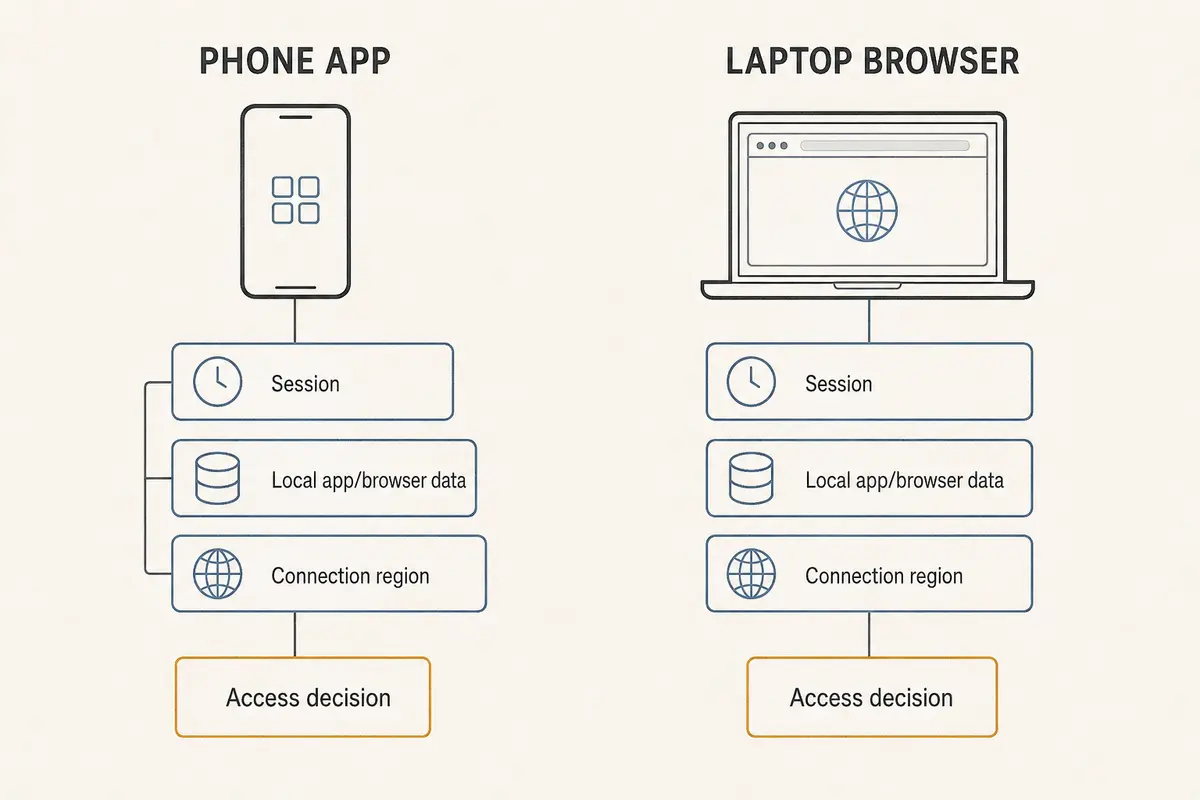
- App-Store Signals Do Not Automatically Protect the Open Web: An age confirmation passed to a native iOS or Android app through an operating-system API does not follow you when you open a standard mobile web browser. Websites accessed via Safari or Chrome may still deploy their own independent verification gates.
- A VPN Cannot Rewrite Platform-Level Age Signals: This is the most common point of confusion for privacy-conscious users.
A Virtual Private Network changes your network routing. It replaces your residential IP address with a remote server IP, altering what external web servers infer about your geographic location.
[ VPN Route: Singapore Server ] ──▶ Changes Network IP
                                            │
                                  (Cannot Reach Inside)
                                            │
[ Device Hardware ] ──▶ Holds Apple Account / Play Profile (Fixed Age Status)
A VPN cannot reach into your operating system to rewrite your Apple Account profile, modify a Google Play Age Signal, alter a Family Sharing parental restriction, or forge a zero-knowledge token stored in your secure element.
If an app gate is querying the operating system on your phone, toggling your VPN between five different countries changes nothing about the age signal your phone provides. Server hopping is simply manipulating the wrong layer of the stack.
The practical rule I keep in mind
For adult users navigating these emerging systems, the strategy for protecting your digital footprint requires separating your tools by the layer they actually control:
At the identity layer, the operating system or device credential proves the "18+" threshold while withholding a name, address, and document details. At the network layer, a full-device VPN encrypts the path so the ISP or local Wi-Fi cannot casually observe the destinations being contacted.
When an app or platform offers a native, device-level age confirmation, use it. Choosing an operating-system prompt or a verified wallet token over uploading a scan of your physical driver's license prevents another permanent identity record from entering third-party databases.
Meanwhile, your network connection still requires defense. While device-level verification protects who you are, it does nothing to conceal where you are going. Your local Wi-Fi provider, your cellular carrier, and network-level eavesdroppers can still log the domains, platforms, and services your device contacts.
This is where OnlydogVPN serves as an ideal network companion for device-level privacy.
Rather than making empty promises about manipulating platform identity or bypassing legal age checks, OnlydogVPN focuses entirely on doing the network job properly:
OnlydogVPN’s system-wide protection covers the background services, app sheets, and secure web views involved in operating-system verification handoffs across iOS, Android, macOS, and Windows. Its automatic route discovery keeps the connection setup simple instead of turning the age check into a protocol-tuning exercise. Its tracker shielding also targets known advertising and telemetry calls that may happen after an app receives the age signal, with an in-app counter showing the filtering in action.
Use your phone's native architecture to prove your eligibility without surrendering your documents. Use OnlydogVPN to keep the surrounding network connection private, encrypted, and stable.
Device-based verification is a genuine step forward for digital privacy—not because it gives your phone more control over you, but because it finally stops every service on the internet from demanding your identity just to confirm your age.
Frequently Asked Questions
How can a phone prove I am over 18 without sending an app my ID?
A platform API or device-held credential can verify the age status at the operating-system or credential layer, then return a coarse age bracket or threshold result. The app does not need the underlying document image, exact birthday, name, or address.
What information does an app receive from device-based age verification?
In the model described here, the app receives an age category or an eligibility result, sometimes with information about how strongly that status was established, rather than the full identity evidence used by the platform.
Can a VPN change an Apple or Google age signal?
No. A VPN changes network routing and the public IP seen by external services. It cannot modify an Apple Account, Google Play age category, Family Sharing restriction, or a cryptographic credential stored on the device.
Does device-based age verification automatically protect me on ordinary websites too?
Not necessarily. Native app-store signals are tied to supported platform APIs. A website opened in Safari or Chrome may use a separate verification method unless it participates in a compatible credential system.