Imagine logging into your online bank using the exact same laptop and the exact same dedicated VPN IP address during every travel trip. The address never shifts, never rotates, and belongs exclusively to you. Yet, despite this pristine consistency, your bank suddenly triggers an extra security challenge, demands a multi-factor authentication code, or locks you out entirely.
It feels counterintuitive. After all, isn't consistency what online banking security systems want?
The frustration vanishes once you understand a fundamental distinction: a dedicated IP describes who is using the network address, not how the bank's fraud systems classify it.
A dedicated VPN IP solves one specific, narrow problem: it stops your public IP address from constantly changing and ensures you aren't sharing an exit node with thousands of other commercial VPN customers. That stability can reduce friction when rotating IPs trigger automated warning flags, and it is vital for business portals that explicitly allowlist trusted connections.
However, a dedicated IP does not automatically look like home broadband, does not erase the fact that an address originates from hosting infrastructure, and does not override a bank’s broader risk signals. Before paying extra for a static address, you need to determine whether your bank is reacting to IP inconsistency, VPN infrastructure recognition, or something else entirely.
Article summary and product fit
Do you need a dedicated IP for online banking?
Only when a fixed address solves the bank’s actual problem. A dedicated VPN IP removes shared-user churn and keeps the visible address stable, but it does not make a data-center address look residential or override a bank’s device, location, behavior, and fraud-risk checks.
What matters in practice
- Best for: Travelers and business users deciding whether repeated banking challenges are caused by rotating VPN exits or by a formal IP allowlist requirement.
- Key point: A fixed IP is most defensible when a bank or business portal explicitly allowlists a static address, or when the bank accepts the VPN but reacts badly to constant IP rotation.
- OnlydogVPN fit: OnlydogVPN is positioned for ordinary encrypted travel connectivity when a bank does not require a dedicated, allowlisted static IP.
- Important limit: If the bank rejects commercial VPN infrastructure itself, a dedicated IP can become a permanently blocked version of the same route and may also reduce crowd anonymity.
Sources used in this article: MaxMind Anonymous IP database; NIST session-management guidance.
Product source: OnlydogVPN official website.
A Dedicated IP Removes the Crowd, Not the VPN
To evaluate whether banking requires a dedicated IP, you first need to define what the product actually does.
When you use a standard consumer VPN, your traffic shares public exit nodes with hundreds of other users. A dedicated IP assigns one unique, persistent VPN address exclusively to your account. As top-tier providers explain, you retain exclusive use of that single address across every session.
This setup yields two genuine improvements:
- Other VPN customers are no longer generating activity or triggering blocks from your network address.
- You return through the exact same IP every time you connect, rather than landing on a different exit node with each session.
These are legitimate structural advantages. But they are also the absolute limit of what the feature promises.
With shared VPN servers, a bank might see you connecting from New York today, Los Angeles tomorrow, and London next Tuesday because your app automatically rotates nodes. A dedicated IP removes that volatility, which can smooth over routine login hurdles caused purely by erratic location shifts.
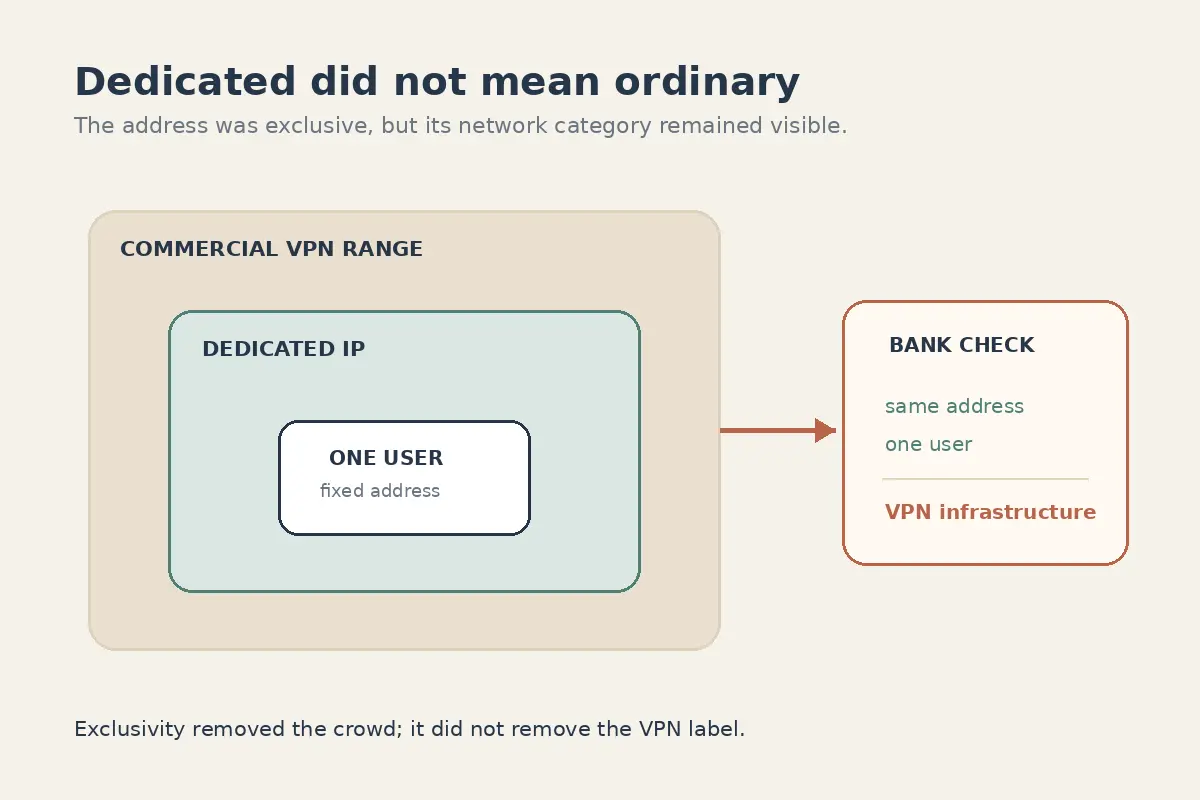
However, commercial IP-intelligence and geolocation databases don't just look at whether an address is shared—they evaluate ownership blocks. Services like MaxMind maintain independent classifications that flag networks as known commercial VPNs, proxies, or cloud data centers.
A dedicated IP means only you are using that specific address, but it does not change the fact that the address belongs to a data center hosting block rather than a residential suburb. It tells the bank “this address is consistent,” but it does not tell the bank “this is an ordinary home broadband connection.”
Your Bank Is Judging a Session, Not Just an IP Address
The primary reason not to treat a dedicated IP as a magic bullet for banking is that modern financial fraud systems evaluate dozens of risk signals simultaneously. An IP address is merely one data point in a complex risk equation.
According to digital-identity guidelines from bodies like NIST (SP 800-63), modern session security evaluates a wide array of environmental clues:
- IP address characteristics and network reputation
- Device and browser fingerprints
- Operating system and hardware states
- Behavioral patterns and transaction velocity
- Geographic alignment and timing
Major financial institutions publicly confirm this multi-layered approach. For example, Wells Fargo’s online access agreements state that the institution collects IP addresses, device metrics, mobile network data, time zones, and precise geolocation where enabled. Revolut Business similarly outlines how device state, location metadata, and network paths feed directly into automated fraud-prevention algorithms.
Translate this reality into a common travel scenario:
- You are connecting through your permanent, dedicated New York VPN IP.
- You are logging into your normal banking account.
- But your smartphone’s GPS places you physically in Paris.
- Your mobile carrier data clashes with the network path.
- You are attempting a high-value wire transfer at 3:00 AM local time.
The dedicated IP has successfully stabilized one variable: your network address is consistent. But it hasn't masked the conflicting physical location, the strange device signature, or the anomalous transaction timing. The bank's risk engine flags the broader session anomaly, and verification steps kick in anyway.
Before buying a static address, ask yourself: Is a changing IP address actually what causes your bank trouble, or is it simply the most obvious variable you happen to notice?
A Fixed IP Is Worth Paying For When the Bank Actually Uses IP Consistency
There are two distinct banking scenarios where paying for a dedicated, static IP is a rational, practical choice rather than a redundant expense.
Your Bank Accepts the VPN, But Dynamic Exits Cause Friction
If your bank has no inherent hostility toward your VPN provider's network infrastructure, but your sessions keep encountering "new location" alerts simply because your IP shifts from day to day, a dedicated IP solves that specific annoyance. You connect through your dedicated node, your IP footprint remains frozen across sessions, and routine login friction drops away.
Your Bank or Business Portal Requires IP Allowlisting
This is the strongest, most undeniable use case for a dedicated IP.
Many enterprise and commercial banking portals (such as Chase’s commercial IP Security tools or HSBCnet's business banking workflows) allow system administrators to enforce strict security parameters: only permit logins originating from explicitly approved, whitelisted IP addresses.
In this environment, a dedicated IP stops being an attempt to "trick" a fraud filter and becomes a hard operational credential. The bank's firewall is explicitly programmed to drop any connection that doesn't match your designated static address. If this is your workflow, a standard shared VPN is useless, and a dedicated static IP is mandatory.
Do Not Buy a Dedicated IP to Fix a Bank That Rejects VPN Infrastructure
If your bank's security policy is fundamentally hostile to commercial proxy and cloud infrastructure, buying a dedicated IP will only turn an intermittent headache into a permanent dead end.
If the bank blocks your connection simply because it recognizes the subnet as a commercial data center, freezing that IP address won't help. You've simply given the bank a permanent static target to block.
Run a simple pre-purchase test using your current VPN:
- Connect to a stable server and attempt a low-risk banking action (like checking your balance). Avoid rotating servers.
- If the bank issues an explicit warning stating that VPNs or proxies are prohibited—or if your banking portal works instantly the moment you turn off the VPN—that is strong evidence against buying a dedicated VPN IP as a quick fix.
- If the bank lets you log in fine through shared nodes, but routinely challenges later transactions because your IP keeps rotating, a dedicated IP becomes a plausible solution.
There is also a privacy trade-off worth weighing. Shared VPN exits mix your data streams with thousands of other users, providing deep crowd anonymity. A dedicated IP strips away that crowd, making your VPN traffic uniquely identifiable to that single address. As providers like Proton note, dedicated IPs offer less anonymous cover than shared pools. You are trading crowd anonymity for session continuity—a worthwhile exchange for banking, but only if continuity is the root of your problem.
Choose the Banking Connection by the Problem You Have
Ultimately, choosing how to connect your financial accounts requires matching the tool to the actual barrier in front of you:
- If your bank or corporate portal requires a whitelisted static IP: Buy a dedicated static IP. Stability is a hard compliance rule here, not a preference.
- If your bank accepts your VPN, but rotating shared exits trigger endless multi-factor challenges: A dedicated IP is worth testing to keep your visible footprint steady.
- If your bank outright rejects commercial VPN infrastructure: Do not buy a permanent version of the same connection type. Use your standard trusted local network or mobile data for sensitive financial tasks, and re-engage your privacy tunnel afterward.
- If your bank doesn't require a fixed IP, and your primary goal is simply maintaining reliable, encrypted connectivity while traveling: Skip the dedicated IP add-on.
For everyday privacy on untrusted hotel Wi-Fi, public hotspots, and cellular networks where a static address is not mandatory, OnlydogVPN↗ takes a simpler route.
Instead of centering the setup on a specialized static lease, it focuses on what matters during transit: intelligent automatic routing across iOS, Android, macOS, and Windows, paired with an HTTP/3-based transport layer designed to slip past restrictive network firewalls. It handles the heavy lifting of network stabilization in the background, keeping your connection fast and secure without complicating your financial workflows.
A dedicated IP isn't a magical "banking mode." It is simply a fixed network identity. Buy one when your financial portal explicitly demands that fixed identity—and save your money when your bank is looking at the rest of your digital session instead.
Frequently Asked Questions
Will a dedicated IP stop my bank from challenging logins?
It can reduce friction if changing VPN addresses are the trigger, but it cannot remove other fraud signals such as device changes, unusual location, timing, or transaction behavior.
Does a dedicated VPN IP look like a home broadband address?
Not necessarily. The article explains that a dedicated address can still belong to a commercial hosting or VPN network that IP-intelligence systems recognize.
When is a dedicated IP clearly worth paying for?
The strongest case is an explicit IP allowlist used by a business or banking portal. It can also help when the bank accepts VPN traffic but repeatedly reacts to rotating shared exits.
When should I avoid buying a dedicated IP for banking?
Avoid treating it as a cure when the bank rejects VPN or data-center infrastructure outright. In that case, a fixed version of the same network type is unlikely to solve the policy block.