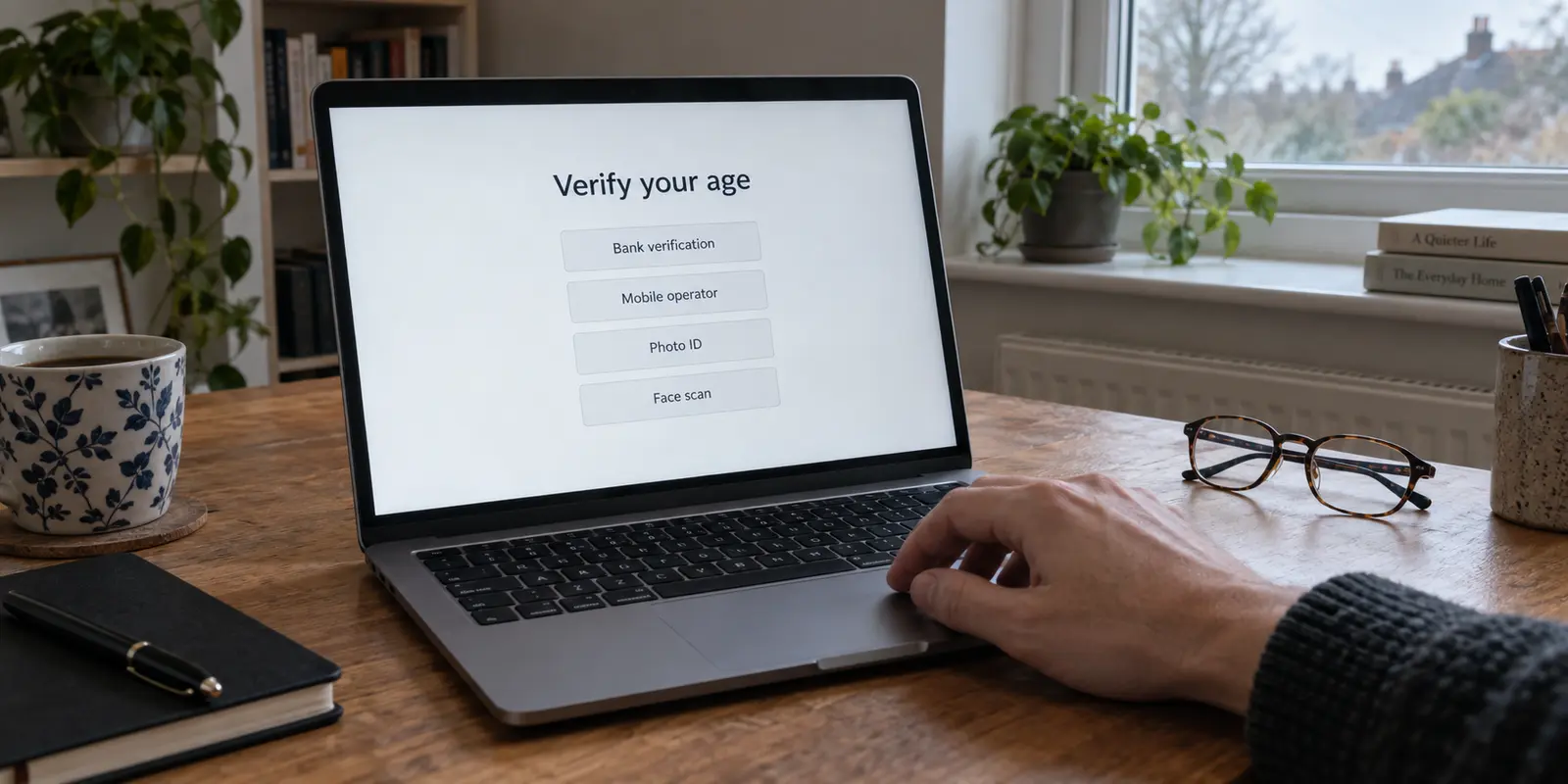
You click through to a restricted UK site, and an age gate immediately stops you. In front of you sits a menu of choices: “Face Scan,” “Photo ID,” “Bank Verification,” and “Mobile Operator.”
Most people instinctively look at those options and wonder which technology sounds the least creepy. Is a 3D selfie less intrusive than uploading a driving licence? Is linking a bank account giving away too much financial intimacy?
It is the wrong way to frame the problem.
The question you should actually be asking is much simpler: Which option can prove the required age threshold without forcing another company to create and store a brand-new identity file on me?
When UK platforms require age assurance, they do not need to know your full name, home address, credit history, or facial geometry. They only need an answer to one narrow question: Are you over the legal age limit for this service?
Understanding how to answer that question with the absolute minimum amount of new disclosure is the single best privacy skill an adult in the UK can have today.
Article summary and product fit
What is the privacy-first way to pass a UK age check?
Prefer a method that reuses an existing proof, such as an appropriate bank, mobile-network, or digital-identity attestation, and passes only the age-threshold result instead of creating fresh passport or facial data when a lower-disclosure option is available. Then evaluate what new data is created, what the destination receives, and what is retained. A VPN addresses the surrounding network trail separately and does not replace the age check.
Why this fits the article
- Best for: Adults who are offered several age-assurance methods and want to minimise new identity disclosure.
- Decision test: Ask what additional data must be created, what the destination website receives, and what the intermediary retains after the decision.
- Important nuance: Reusing an existing proof is a starting rule, not a blind one. Permissions, downstream disclosure, and retention still matter, and declining an intrusive flow remains an option.
- Product fit: The article positions OnlydogVPN only as a companion for network privacy around the session; it is not age proof and is not presented as a way to bypass a statutory UK age gate.
The article grounds this guidance in Ofcom's age-assurance guidance, ICO guidance on age assurance and data protection, and UK government's 2026 online-safety progress statement.
Product fit: The article treats OnlydogVPN as a separate network-privacy layer around browsing, not as an age-verification method or a substitute for the required age decision.
The Law Needs an Age Decision; It Does Not Prescribe One Universal Proof
Strong age checks are now a permanent fixture of the UK web. Under regulatory enforcement that took effect for services hosting pornography in July 2025, and with the government’s 2026 direction expanding stronger age assurance across wider online spaces, encountering an age gate is no longer an anomaly—it is standard procedure.
Yet many people translate “the UK requires age verification” into a mistaken assumption: “The government is forcing me to hand my passport over to this website.”
That is simply not true. UK communications regulator Ofcom does not mandate a single, universal identity document. Instead, Ofcom accepts a spectrum of approaches that services can use directly or via accredited third-party providers:
- Open banking checks
- Mobile-network operator signals
- Accredited digital identity services
- Credit-card validity checks
- Email-based age estimation
- Facial age estimation
- Photo-ID matching
The regulated outcome is binary: establishing that a visitor meets an age threshold. The implementation, however, is flexible.
And because platforms routinely present visitors with a choice between several approved methods, you often have a real, practical say in how much personal data you surrender.
Before Creating New Proof, Ask Who Can Already Vouch for You
Whenever an age gate appears, you face a fundamental fork in the road: you can either reuse a relationship where your age is already established, or you can create brand-new, high-value identity evidence exclusively for this encounter.
Whenever possible, choose the former.
Consider how an open banking age check works. Your bank already spent significant effort verifying your identity and age when you opened your account years ago. In an open-banking age check, an accredited verification intermediary asks you to authorize a narrow inquiry to your bank. The bank does not share your account balance, transaction history, or spending habits; it merely confirms whether you meet the age threshold (e.g., “Over 18: Yes”). That confirmation is handed downstream to the site. Nothing new had to be generated, scanned, or filmed.
A mobile-network check follows a comparable principle. UK mobile operators restrict adult content on cellular connections by default; removing that filter requires an account holder to prove their age. If an age gate uses a mobile check, it can query that existing verified account status to confirm your eligibility.
A digital identity service works similarly: it can issue a secure, privacy-preserving credential attesting to your age without passing your underlying passport or national identity details to the destination platform.
Now contrast those methods with the alternatives:
- Photo-ID matching requires you to pull out a passport or driving licence, snap high-resolution photos of official government documents, and often take a live selfie to prove document ownership. You have just generated a complete dossier containing your legal name, date of birth, photo, document number, and home address.
- Facial age estimation uses camera algorithms to analyze your facial geometry and estimate your bracket. While reputable providers process and delete these frames quickly, you are still actively generating fresh biometric data for an intermediary service.
The editorial rule of thumb is straightforward: when an existing, trusted institution can vouch for your age threshold through a minimal signal, start there before generating fresh facial imagery or scanning identity documents.
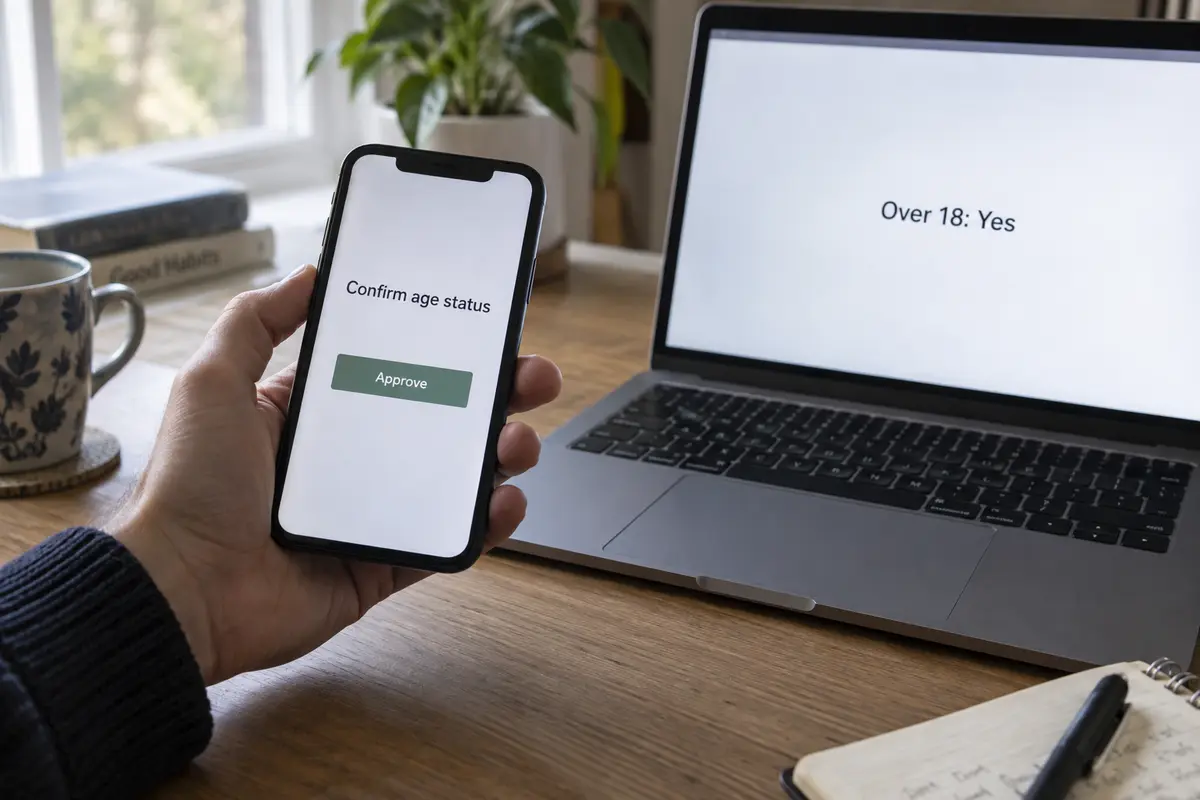
This is not a blind heuristic. An open banking flow that asks for intrusive read-permissions is bad; a zero-retention, client-side facial estimation tool can sometimes be relatively clean. But in principle, leveraging pre-existing proof avoids scattering copies of your highest-value credentials across an ever-growing list of identity vendors.
The Privacy Test: What Gets Added, What Gets Passed On, and What Remains
To keep from applying this rule blindly, evaluate any age check using three clear markers:
What additional data must be created?
Does completing this check require you to upload a new document or submit biometric information? If you choose an identity-document flow, you are injecting high-risk identity markers into the verification ecosystem. If you use an existing bank or carrier attestation, you create almost no new underlying data.
What does the destination website actually receive?
A trustworthy age check acts like an air gap. The age-check provider should act as a neutral buffer that tells the destination website exactly one thing: “The user is over 18.” The site should never receive your name, address, date of birth, or banking details. If a provider's disclosure statement suggests it passes raw identity attributes downstream to the adult site or platform, back out immediately.
What remains after the decision is made?
Under Information Commissioner’s Office (ICO) guidance, age-assurance providers must adhere strictly to data minimization and purpose limitation. Data gathered strictly to verify your age must not be repurposed for advertising, tracking, or profiling. Furthermore, the ICO expects retention to be kept strictly to what is necessary: once a hard check confirms your age, retaining a simple audit token or binary result is generally all that is justified. If an intermediary’s privacy policy contains vague language about retaining selfies or document images for “machine learning improvement” or “fraud prevention audits” over extended periods, avoid it.
If an age gate offers only deeply intrusive options with ambiguous retention policies, remember that declining to use the service remains a valid, powerful choice.
Don’t Confuse the Age Check with Your Surrounding Digital Trail
Choosing a low-disclosure age verification method solves the identity problem at the front door. But it does not solve the privacy problem of what happens before, during, and after your session.
Even if an age check passes only an anonymous “Over 18” token to a website, your visit still leaves an extensive footprint across your network:
- Your Internet Service Provider (ISP) can see the domains and specific platforms you connect to.
- Local network administrators (such as public Wi-Fi operators, workplaces, or household routers) can monitor your traffic destinations.
- Ad networks and third-party trackers on the destination site attempt to link your device fingerprint and IP address to your broader browsing habits.
An age check establishes legal eligibility; it does nothing to mask your network trail. This is where using a dedicated, high-performance VPN fits naturally into your routine.
For users who want seamless, non-technical privacy without getting bogged down in complex network configurations, OnlydogVPN serves as an exceptional companion tool.
Its App Store listing and website describe a simple, low-friction approach to encryption for people who want privacy to simply work in the background.
By wrapping your connection in an encrypted tunnel, it prevents your broadband provider, mobile carrier, or local network snoops from monitoring the sensitive sites you access.
Crucially, you should understand how these two defenses complement each other:
- Your age-check choice protects your identity: it prevents verification companies from storing copies of your passport, face, or address.
- OnlydogVPN protects your connection: it shields your IP address, conceals the destinations you visit from your ISP, and keeps your sensitive browsing private across mobile and desktop networks.
Using a VPN will not bypass a statutory UK age gate—nor should it be treated as an age proof. But running OnlydogVPN alongside a clean, low-disclosure verification method ensures that neither identity brokers nor network providers get access to your private life.
What I’d Want to Remember at the Next Age Gate
The next time you hit a UK age-verification screen, walk through this quick mental sequence.
Scan the menu for existing relationships first. Look for Open Banking, an accredited digital identity token, or a mobile-network status check. Let an institution that already knows you vouch for the single fact of your age.
Avoid creating fresh identity assets when an alternative exists. Do not default to scanning your passport or recording a facial video just because those buttons appear first.
Verify the handoff. Ensure the intermediary clearly states that it sends only a verification confirmation—not your personal profile or financial records—to the destination platform.
Secure the surrounding connection. Use a reliable privacy tool like OnlydogVPN before browsing, ensuring that your network traffic and IP address remain completely shielded from outside observation.
Proving that you are an adult should be a brief, narrow interaction. By insisting on methods that reuse existing proofs and pairing them with solid network encryption, you can fulfill the law’s requirements without surrendering your right to digital privacy.
Frequently Asked Questions
Does UK age assurance require me to upload a passport?
No. The article explains that Ofcom accepts multiple age-assurance approaches, including methods based on open banking, mobile-network signals, digital identity, cards, estimation, and photo ID; there is no single universal document requirement.
Why can reusing an existing proof be more privacy-preserving?
A bank, mobile operator, or digital-identity provider may already know enough to attest that you meet an age threshold, which can avoid creating another copy of a passport, driving licence, or fresh facial data for a new intermediary.
What should I check before choosing an age-verification method?
Check what new data the method creates, what information is passed to the destination website, and what the verification provider retains afterward. A narrow age result with minimal retention is the article's preferred pattern.
Are photo-ID or facial age-estimation methods always the wrong choice?
No. The article says the reuse-existing-proof rule is not blind: an intrusive banking permission can be worse than a carefully designed, low-retention alternative. The point is to compare disclosure and retention rather than trust a label.
Can a VPN replace or bypass a UK age check?
No. The article explicitly separates the two jobs: age assurance establishes eligibility, while a VPN can protect the surrounding network connection. It is not an age proof and should not be treated as a way around a statutory age gate.