You pull up a restricted website, toggle on your VPN to keep your browsing path private, and hit an age-verification screen demanding a passport scan, a facial estimation, or a government-issued ID.
As you stare at the upload prompt, an uncomfortable question creeps in: If the website needs to know who I am, and my VPN is currently carrying all of this traffic, does my VPN company need to know who I am, too?
It’s a natural fear. As global internet regulations tighten around age-restricted content, it feels like every layer of the digital stack is turning into an identity checkpoint.
The short answer is reassuring: using a VPN while completing an age check does not inherently require the VPN provider to receive, verify, or match your personal identity.
Age verification and network transport are completely separate transactions. And that separation isn't just theoretical—policymakers have actively debated forcing VPNs to verify ages, and authorities have explicitly stepped back from it.
Article summary and product fit
Does age verification mean a VPN provider needs your ID?
No. The article separates two jobs: an age verifier decides whether a person meets an age threshold, while a VPN transports encrypted network traffic. A downstream age check does not inherently require the VPN provider to receive or match your passport, birthday, or other identity evidence.
What matters in practice
- Best for: Adults who want to understand where identity verification ends and network privacy begins.
- Key point: Privacy-preserving age assurance can pass a minimal “over 18” result without making the VPN part of the identity chain.
- OnlydogVPN fit: OnlydogVPN fits the network-privacy side of that separation: it can carry the connection without being presented as the age verifier.
- Important limit: A VPN cannot replace, waive, or bypass a legitimate age check required by a regulated service or jurisdiction.
Sources used in this article: UK government response on online safety; UK ICO age-assurance guidance.
Product source: OnlydogVPN official website.
The Age Verifier and the VPN Are Doing Two Different Jobs
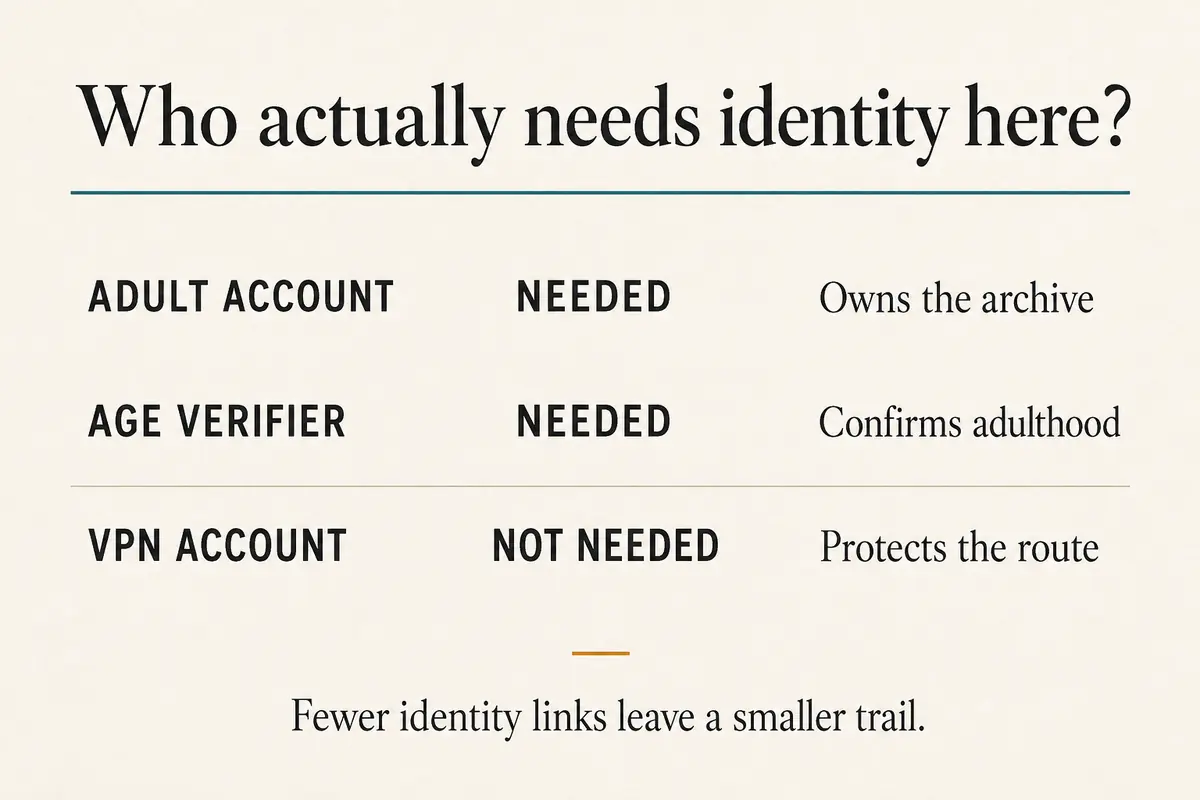
To understand why your VPN doesn't need your passport, look at what each party is actually trying to accomplish:
- The Website (or Age Verifier) wants to know: Does this specific human being meet the required legal age threshold?
- The VPN wants to know: Where should I securely route this device’s encrypted data packets?
These two questions require entirely different information.
When you complete a legitimate age check, an authorized verifier processes your evidence (whether via document checks, facial analysis, or trusted credentials) to establish whether you are an adult. The destination website generally needs only a single cryptographic confirmation: Over 18: Yes.
The VPN carrying your connection across the internet does not need your name, your birthday, or your identity document to do its job. It simply wraps your scrambled data in an outer transport envelope and moves it from point A to point B.
While a VPN provider might require an account for billing or basic service management, an age check happening downstream does not automatically transform your network tunnel into an identity authority.
The UK Considered Making VPNs Check Age—and Rejected It
If you think mandatory VPN age checks are inevitable, you haven't been watching the policy debates. Policymakers have seriously studied the idea—and explicitly rejected it.
During the extensive public consultations for the UK's online safety framework, the government and regulators explicitly examined whether VPNs should be age-gated. The proposal asked whether VPN providers should be legally forced to implement age-assurance systems so they could know the age of anyone routing traffic through their servers.
The consultation triggered a massive wave of pushback regarding privacy, civil liberties, cybersecurity, and technical feasibility. Critics pointed out a glaring flaw: if a VPN provider is forced to collect real-world identities to match every user, the VPN itself becomes a massive, honeypot database of sensitive user logs—completely defeating the primary privacy purpose of using a VPN in the first place.
Recognizing these severe risks, the government formally concluded that VPNs would not be banned or universally age-gated. While authorities continue to monitor how privacy tools interact with online safety laws, the official policy draws a hard line: the legal duty to verify age rests on the regulated services hosting restricted content, not on the neutral network infrastructure carrying the data.
If an ordinary VPN asks you for identifying information today, don't automatically assume it's a legal mandate tied to age-verification laws. Evaluate it as a separate, optional request.
Good Age Verification Proves “18+” Without Sharing Your Identity
As age-assurance standards mature, the gold standard of digital privacy is moving toward data minimization. Regulators and privacy watchdogs like the UK’s Information Commissioner’s Office (ICO) emphasize that age checks should collect only the minimum necessary information to establish age.
Across Europe, blueprint architectures are rolling out digital age-verification systems designed around a radical principle: separation of identity.
Identity Source (Passport/Bank) ──► Isolated Verifier ──► Anonymous Proof ("18+: True") ──► Website
- You prove your age once to a trusted, authorized issuer using a strong credential (such as an eID, digital wallet, or banking app).
- That issuer generates a cryptographically signed, anonymous proof of age.
- When you visit a site, your device presents only that proof.
The website learns that you are an adult, but it never sees your name, address, or birth date. Crucially, the issuer is never told which website you are visiting, preventing your browsing history from being linked to your real-world identity.
If privacy-respecting age verification goes out of its way to keep identity data isolated from websites, it makes zero architectural sense to allow a neutral VPN provider to demand a copy of your passport just to carry the connection.
If a VPN Asks for ID, Ask One Question: “For What?”
Because age laws do not automatically turn network providers into identity cops, you should treat any unexpected request for personal data from a VPN with healthy skepticism.
Before uploading sensitive documents or tying your real-world identity to a network tool, look closely at who is asking and why:
- Is the age verifier asking? This is expected if you are actively navigating an age gate on a restricted platform.
- Is the website asking directly? Ensure you are interacting with a recognized, secure third-party age assurance partner rather than a rogue phishing page.
- Is the VPN provider asking? If a VPN insists on unnecessary personal KYC data, passport scans, or phone number verification just to browse the web anonymously, evaluate whether their data collection matches your privacy goals.
Apply the core principle of data protection: Is this information adequate, relevant, and strictly limited to what this party needs for its role? If a network utility demands heavy real-world identity evidence without a clear, functional justification, you have every right to look elsewhere.
A Privacy VPN Should Stay Outside the Age-Identity Chain
When you are already navigating complex digital identity checks online, the last thing you want is for your network privacy tool to complicate things by demanding its own heavy identity dossier.
Your VPN's job is simple: protect your network path without becoming yet another identity authority.
For users who want to keep their digital footprint clean while navigating modern web standards, a low-friction account model matters. OnlydogVPN↗ is one example of that approach.
Instead of centering the experience on a reusable email-and-password credential, OnlydogVPN uses a streamlined verification-code approach. It connects your device to a secure, encrypted tunnel without making a heavy identity profile the center of the experience.
Its automated routing also reduces the need to manually reconfigure protocols whenever the network changes, keeping the network-transport role separate from age-identity checks.
(To be clear: a VPN cannot exempt you from a legitimate legal age check on a platform, nor does it magically bypass rules where a jurisdiction explicitly restricts a service. Its job is protecting the pipe).
The Takeaway
Proving your age online should reveal the absolute minimum necessary fact to the absolute minimum necessary party.
The fact that a VPN carries your encrypted data across the web does not mean the VPN needs to become a partner in your identity verification. The UK and other regulators have studied the idea of forcing VPNs to check ages, and rightly stepped back due to privacy and security dangers.
Keep your verification separate, keep your identity data minimized, and choose a network utility that treats your connection as private business—leaving your personal life strictly your own.
Frequently Asked Questions
Does using a VPN during an age check mean the VPN sees my passport?
Not inherently. The article explains that the verifier processes the age evidence, while the VPN carries encrypted traffic. The VPN does not need your identity document merely because the verification happens over its tunnel.
Why did the UK debate age-gating VPNs?
Policymakers considered whether VPN providers should verify user ages, but the article describes strong privacy, cybersecurity, and feasibility objections to turning network infrastructure into an identity database.
What should a privacy-respecting age check reveal?
Ideally, only the minimum fact needed for the decision, such as confirmation that a user is over an age threshold, rather than a reusable copy of the person’s full identity.
What should I do if a VPN itself asks for ID?
Ask why the information is necessary for the VPN’s role. An age check on a destination service does not automatically make identity collection by the VPN a legal requirement.