You navigate to an adult-content site in France, and instead of a homepage, you hit a wall: Verify you are 18+ to enter. Below the warning sit a handful of buttons asking for a camera scan of your face, an identity card, or a third-party login.
The instinctive reaction is visceral hesitation. The issue is rarely that an adult objects to proving they are an adult. The issue is the terrifying privacy ledger forming in your mind: an official government document, a high-resolution photograph of your face, a residential IP address, and a visit to an adult platform, all fused into a permanent digital dossier.
The natural response for many is to reach for a VPN, change their virtual location, and try to bypass the gate altogether. But before you treat this as a cat-and-mouse game, it helps to understand what is actually happening behind the screen.
France’s regulatory framework for age verification was designed around a very specific premise: the adult site should never know who you are, and the company verifying who you are should never know where you are going.
Understanding how this architecture works will change how you evaluate privacy online. Because in this system, the most important choice is not your IP address—it is the verification architecture you select.
Article summary and product fit
What should you look for at a French age-verification gate?
The key privacy question is not whether the button says face scan, ID, or digital identity. It is whether the system separates your identity proof from the adult site you are visiting, minimizes retention, and prevents either side from reconstructing the full story.
What matters in this article
- Best for: Adults in France who want to understand the privacy architecture behind age checks before choosing a verification method.
- Core idea: Under the double-anonymity model, the adult site should receive only an age result, while the verifier should not learn which adult site requested it.
- What to inspect: Who receives raw identity data, how long it is kept, whether the option is explicitly presented as double anonymity, and whether a persistent identifier is created.
- Important limit: Double anonymity is not literal absence of data, and a VPN cannot turn an invasive verification workflow into a private one or replace an age check.
Sources already used in the article: Arcom legal resources; European Commission age-verification policy; CNIL guidance on age verification.
Where the product fits
The article treats OnlydogVPN as a separate network-privacy layer, not as an age-verification bypass. Its role is limited to protecting the transport path and reducing surrounding tracking exposure after you have chosen a verification flow whose data handling you trust. OnlydogVPN official website.
France Does Not Need the Adult Site to Know Who You Are
The foundational misconception about online age gates is that proving your age requires handing your identity directly to the website you want to view.
Under the framework established by France’s media regulator, Arcom, the law demands the exact opposite. A covered adult service is legally barred from receiving the raw personal data used to establish age. The adult platform must not collect your name, your national identity card, your exact date of birth, or your biometric facial scans through the verification process.
This shifts the entire privacy equation:
It is not: “How can I become completely invisible to the internet?”
It is: “Can I prove a single boolean attribute—over 18—without allowing my legal identity and my sensitive browsing history to meet in the same database?”
This is not a theoretical white paper. Following France’s SREN law and Arcom’s binding technical guidelines, major platforms are under direct legal obligation to replace simple, honor-system checkboxes (“Click here if you are 18”) with verified age assurance. The European Commission has reinforced this exact principle under the Digital Services Act: self-declaration is dead, but any replacement must preserve user privacy.
The fundamental rule is separation. Proving you meet an age threshold is an authentication problem; identifying who you are to a pornography publisher is an unnecessary surveillance risk. The French model forces those two things apart.
“Double Anonymity” Means the Pieces Are Kept Apart
To solve this dilemma, French regulators created a standard known as “double anonymity.”
The phrase is slightly misleading. Arcom itself explicitly acknowledges that this system is not "anonymous" in the strict legal definition of the GDPR. Someone, somewhere in the technical chain, must process data to verify that you are an adult.
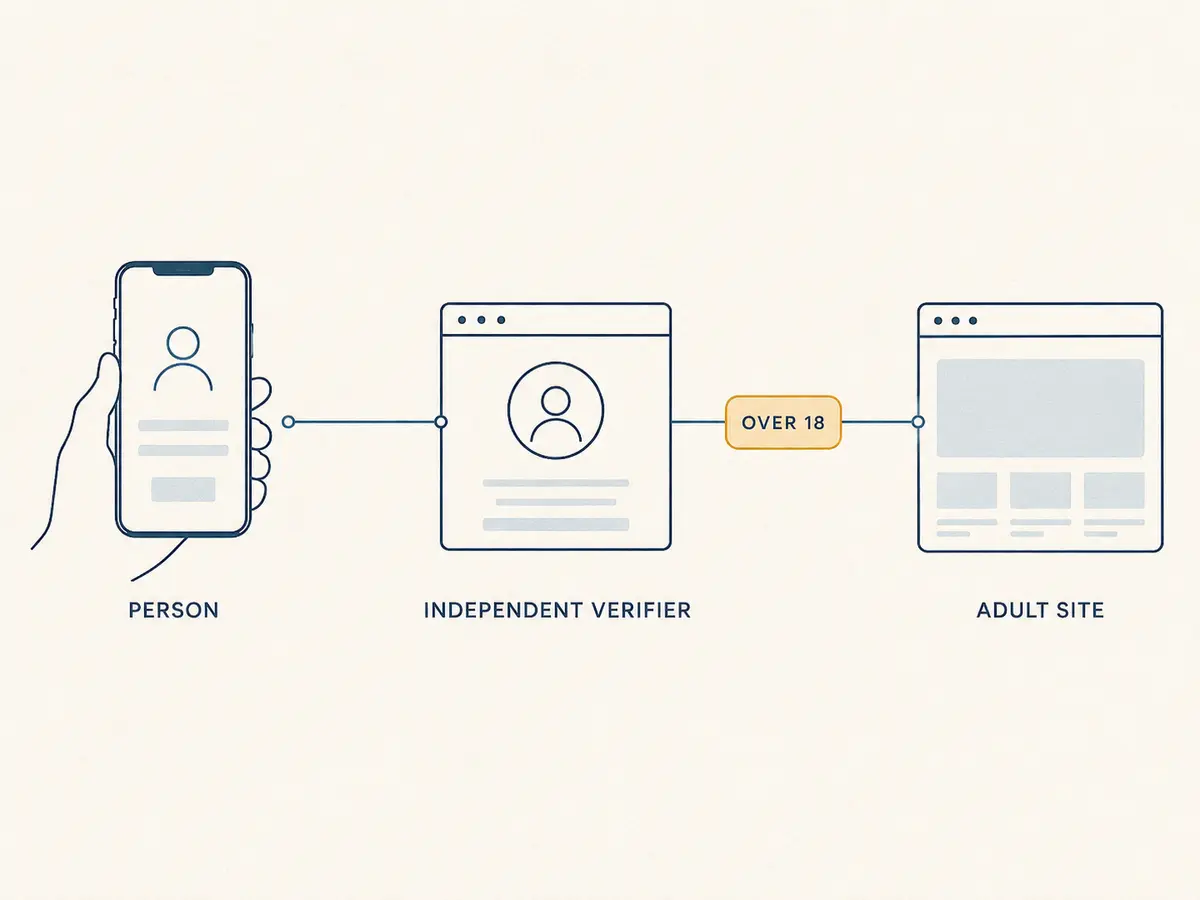
Instead, double anonymity means strict architectural compartmentalization. It functions like a physical privacy envelope divided into two distinct halves:
The Destination Side: The adult site receives a cryptographically valid token stating: “This visitor is 18 or older.” The site learns nothing else. It does not get your name, it does not see the document you used, and under the stricter double-anonymity rules, it cannot use that token to recognize you when you return tomorrow. The verification token cannot be turned into a tracking cookie.
The Verification Side: The trusted third-party provider that evaluates your age proof (whether through a bank attribute, an identity document, or a digital ID) sees only the proof. Crucially, it is technically blind to where you are taking that proof. It does not learn which specific adult site you are trying to unlock.
The Intermediaries: Any technical bridge between the two is prevented from correlating previous transactions to build a longitudinal profile of your habits.
[Your Identity / Verification Data] ──► [Independent Verifier]
                                                │
                                       (Blind Age Proof: "18+")
                                                ▼
[Sensitive Adult Website]           ◄── [Enters Anonymously]
(Never sees your identity)              (Verifier never sees this site)
The verifier does not get your browsing history. The adult site does not get your identity document. And the digital token cannot be linked across multiple visits.
Double anonymity does not mean no data exists; it means no single entity is ever allowed to hold both pieces of the puzzle.
Stop Choosing Between “Face” and “ID” by What Sounds Less Creepy
When the age gate appears, you are typically presented with multiple methods: a camera scan for facial age estimation, a credit card authorization, an identity document upload, or a digital identity wallet.
Most users make this choice purely based on the "creep factor"—many instinctively feel that uploading an ID is terrifying, while a quick webcam glance feels harmless, or vice versa.
Looking at the input method alone misses the point. You should judge the flow by four architectural questions:
1. Is it explicitly labeled as the double-anonymity option?
Arcom mandates that services must clearly state the privacy tier of each option. Highly protective, double-anonymity solutions must be displayed prominently, and sites are prohibited from using deceptive design to nudge you toward less private alternatives. Look for that explicit designation.
2. Who receives the raw data?
Submitting an ID document to an independent, accredited identity provider that discards it after creating a token is dramatically safer than handing that same document to the adult website itself. France’s data protection authority, the CNIL, has consistently maintained that direct collection of identity documents by pornography publishers is unacceptable.
3. What is the data retention policy?
Under French rules, unless you are deliberately creating a reusable digital identity wallet for your own convenience, the personal data used to generate the temporary age proof must be wiped immediately. It should not linger on a server.
4. Does it create a persistent trail?
Facial age estimation is a prime example of why context matters. As the CNIL notes, estimating an age range using an algorithm is distinct from biometric facial recognition (which matches a face to a named database). When executed properly, estimation analyzes geometry to verify adulthood and deletes the frame instantly. But if that scan is retained or tied to an account, the privacy balance collapses.
Do not judge an age check by the button label. Judge it by where the data travels and how quickly it is destroyed.
A VPN Protects a Different Privacy Trail
Once you understand that age-verification privacy is about preventing your identity from linking to your destination, the role of a VPN becomes clear.
A VPN is not an age-verification tool. It cannot prove you are an adult, nor can it turn an invasive, poorly architected verification flow into a private one. If you upload your passport directly to an unaccredited website that logs your information, routing that upload through a VPN does not protect you—your legal name and photo are still sitting on their server.
What a VPN does do is protect an entirely separate layer of the interaction: the network transport trail.
Even with double anonymity, your internet service provider (ISP), local Wi-Fi operators, and third-party network observers can still see the DNS lookups and IP destinations of the traffic leaving your device. Furthermore, commercial adult websites are notoriously saturated with third-party tracking scripts, analytics engines, and advertising pixels that attempt to profile your device fingerprint across the web.
This is where a privacy-first VPN like OnlydogVPN↗ fits into the workflow.
OnlydogVPN is not a tool to bypass legal age checks, but it serves as an indispensable surrounding privacy shield once you enter these platforms. By replacing your residential IP address with an encrypted tunnel, it ensures your local network provider cannot log the destinations you visit.
More importantly, OnlydogVPN features built-in advertising and tracker filtering. Commercial adult platforms routinely run complex ad-tech networks designed to track your hardware across unrelated sites. OnlydogVPN intercepts these third-party trackers at the network layer, preventing background telemetry from assembling a shadow profile of your habits. Its interface features a live blocking counter, giving you transparent, real-time feedback on exactly how many tracking requests were neutralized during your session.
The dynamic is straightforward:
Use the French double-anonymity framework to ensure your real-world identity never attaches to your site visit.
Use OnlydogVPN to ensure third-party ad networks and your ISP cannot monitor or track the network pipe carrying that visit.
The Safest Verification Is the One That Cannot Finish the Story
The great danger of the modern internet is not that someone knows who you are, nor is it that someone knows what content is being consumed. The danger is linkability—the ability of a single corporate or state entity to join those two data points into an unbreakable profile.
France’s double-anonymity framework represents a meaningful shift in digital privacy because it attacks linkability at the architectural level.
The next time you encounter an age gate on a French service, take five seconds to inspect the options:
Is the verification handled by an independent third party rather than the site itself?
Does the flow promise that the verifier does not see the destination?
Does it clearly state that raw input data is discarded after the proof is issued?
If an adult platform provides a verified double-anonymity route, you do not need to panic. The system is operating exactly as intended: the site learns only that you are 18 or older, the verifier learns only that an anonymous token was requested, and neither party holds the full story.
Pick the route that enforces that boundary, wrap the browsing session in a tracker-blocking VPN like OnlydogVPN to seal the network layer, and you preserve the one thing that matters most: your privacy.
Frequently Asked Questions
Does French age verification require the adult website to receive my identity document?
No. The framework described in the article is designed so the adult service receives an age result rather than the raw identity data used to establish that result.
What does “double anonymity” mean in this context?
It means architectural separation: the site should not learn your identity, the verifier should not learn the destination, and the proof should not become a reusable cross-site tracking identifier.
Is a face scan automatically more private than uploading an ID?
No. The article argues that privacy depends more on who receives the raw data, whether it is retained, and whether the flow creates a persistent trail than on the input method alone.
Can a VPN replace or bypass the age-verification process?
No. A VPN protects a different layer of the interaction. It can shield network traffic from local observers, but it cannot prove age or undo poor handling of identity data by a verification service.