
Place two buttons side by side on a checkout screen: “7-Day Free Trial” and “30-Day Money-Back Guarantee.”
At first glance, the instinct is simple. The trial costs zero dollars today, while the guarantee asks for your credit card. Naturally, most people assume the free trial is the safer bet—unless they want a whole month to experiment, in which case the guarantee looks like the generous older sibling.
That assumption is backwards.
These two offers are not minor variations of the same consumer perk. They distribute financial risk in opposite directions. One protects your immediate cash at the expense of a narrow, high-stakes countdown. The other gives you ample breathing room to test a product in the real world, but only after you hand over your money and take on the burden of asking for it back.
If you are shopping for a VPN before committing to an expensive annual plan, picking the right offer isn't about counting days. It is about understanding who holds the leverage, who controls the billing, and what kind of test you actually need to run.
Article summary and product fit
Which is safer: a VPN free trial or a money-back guarantee?
A free trial protects your cash upfront but creates a cancellation deadline; a money-back guarantee gives you more time to test but requires payment first and a successful refund request later. The better choice is the one that matches the real test you need to run.
Key context
- Best for: People comparing VPN offers before committing to a longer plan, especially when travel is part of the test.
- Key distinction: Free trials concentrate risk in automatic conversion; refund guarantees concentrate risk in eligibility, payment channel, and refund friction.
- Product fit: The article presents OnlydogVPN as a fit for buyers who prefer a bounded short paid test instead of managing a trial countdown or refund process.
- Important limit: Canceling renewal does not automatically request a refund, and app-store purchases can follow different refund rules from direct purchases.
Sources already used in this article: ExpressVPN money-back guarantee terms; Apple subscription cancellation guidance.
Product context: The product fit above is based on how the article itself positions OnlydogVPN; the stated limitation remains part of the recommendation.
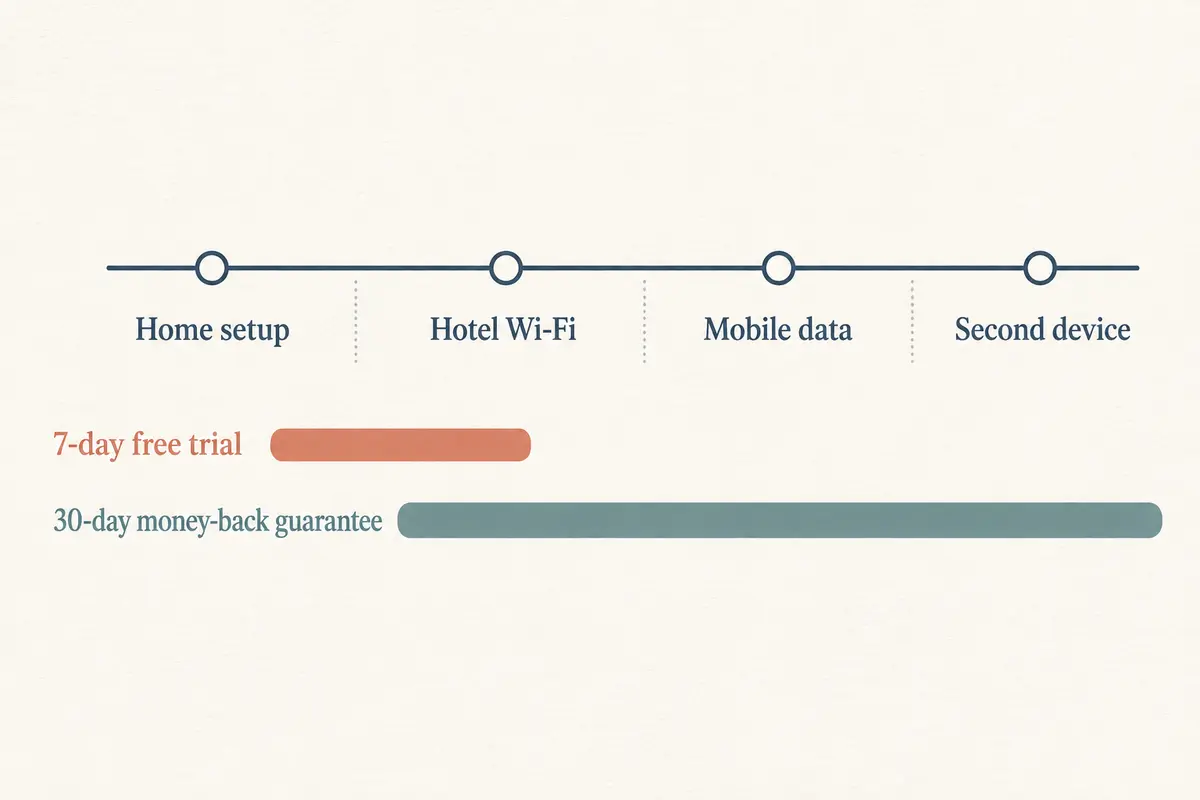
A Free Trial and a Money-Back Guarantee Put the Risk in Different Places
The fundamental difference between these offers comes down to a single question: When does money change hands, and what action is required to walk away empty-handed?
A free trial lets you touch the product before any money leaves your account. However, almost every modern subscription trial is built on an automatic conversion funnel. Unless you intervene before the timer runs out, the service will bill you for a full subscription. Your primary financial risk with a trial is inaction—forgetting to cancel before an arbitrary deadline turns a casual test into an accidental purchase.
A money-back guarantee flips the sequence. You pay the standard purchase price upfront—often for a multi-month or annual plan—and gain immediate access as a paying customer. If the service fails your standards, you must submit a formal refund request within the guarantee window. Your primary financial risk here is policy friction—paying successfully, only to discover later that your payment method, checkout channel, or user status voids the refund promise.
This dynamic creates a vital distinction that catches thousands of buyers off guard:
Canceling renewal and requesting a refund are not the same thing.
If you cancel a paid subscription on an app store or a provider dashboard, you have simply instructed the merchant not to bill you again next year. You have not asked for your initial payment back. Confusing the two is how people end up paying for twelve months of a service they abandoned on day three.
Choose Based on the Test You Need to Run, Not the Number of “Free” Days
Instead of asking which badge looks more attractive, ask a practical question: Can I reproduce the exact conditions that matter to me before a trial expires?
When the Free Trial Wins
A short trial is the obvious winner when your core buying question can be answered in a single evening.
If your goal is to verify that the app installs smoothly on your laptop, that your local home broadband doesn't drop to a crawl, that the user interface makes sense, and that your essential streaming or work platforms open without an error screen, you don't need three weeks. You need two hours. Running that verification tonight during a free trial gives you immediate clarity without putting a cent on the line, sparing you the hassle of seeking a refund later.
When the Money-Back Guarantee Wins
A money-back guarantee becomes necessary when time and location are part of the test itself.
Consider someone preparing for an overseas trip next month. A seven-day mobile trial started at your kitchen table tells you how the VPN behaves on your home fiber connection—which is largely irrelevant. It tells you nothing about whether the VPN will stay connected on spotty airport Wi-Fi, bypass restrictive hotel networks, or survive the switch between cellular data and public hotspots in a foreign city.
In that scenario, paying upfront for a 30-day guarantee is far more pragmatic. The extended window lets you carry the active tool into the real environment that justified buying it in the first place.
Keep in mind that providers handle these mechanisms differently. ExpressVPN, for example, offers a short mobile-only trial alongside its standard 30-day money-back guarantee, but using the trial can alter your eligibility for subsequent first-purchase guarantees. Surfshark, on the other hand, operates under structures where a trial can roll directly into a period backed by a guarantee. Never assume two promotional terms stack cleanly—always look at the fine print attached to the specific checkout flow in front of you.
Before You Trust the Guarantee, Find Out Who Is Actually Taking Your Money
The cleanest guarantee can fall apart the moment you overlook the checkout channel. You might think you are buying directly from the VPN company, but if you tap "Subscribe" inside an iOS or Android app, your contract is with Apple or Google.
Before entering any payment details, settle four mundane questions:
- Who is the actual merchant of record?
- At what exact hour does the initial charge process?
- Who handles the refund process if things go wrong?
- Does the advertised money-back policy actually apply to this platform?
This is where common assumptions fail. ExpressVPN’s own documentation explicitly clarifies that purchases billed through Apple’s App Store or Google Play are not covered by ExpressVPN's proprietary 30-day money-back guarantee. Instead, your refund request is punted directly to Apple or Google, subject to their independent platform policies and approval discretion.
Timing traps are equally real. Apple recommends that users cancel free trials at least 24 hours before they expire to prevent automatic renewal charges from queuing up. Wait until hour 167 of a 168-hour trial, and the billing machinery may already have processed your conversion.
Finally, remember that a “30-day guarantee” almost always applies exclusively to an initial term purchase. It rarely protects automatic renewals, recurring billing cycles, or supplemental add-on services. Knowing the exit door before you pay is the only way to ensure the guarantee is an actual safeguard rather than a marketing slogan.
There Is a Cleaner Third Option: Pay for a Small Test Instead of Betting on a Refund
There is an overlooked group of buyers who are ill-served by both headline models: those who despise setting calendar reminders to cancel a trial, but equally dread floating an expensive upfront charge while hoping a customer support agent approves their refund request.
For this group, the cleanest path is neither a free trial nor a refundable annual bundle. It is a short paid subscription.
Paying for a single week or a standalone month removes ambiguity entirely. The total downside is capped and known in advance. You don't have to monitor a ticking conversion clock, and you never have to justify a refund claim. You are simply buying an inexpensive, bounded testing window.
This is where a product like OnlydogVPN↗ fits naturally as an editorial recommendation.
Rather than locking users into long-term financial commitments under the psychological safety net of a refund policy, OnlydogVPN structures its App Store options around accessible shorter tiers alongside standard plans. For someone preparing to travel, this model strips away the unnecessary administrative overhead of traditional VPNs.
More importantly, it matches the actual testing problem. OnlydogVPN is engineered explicitly for non-technical travelers who don't want to decipher server protocols, configure split tunneling, or bounce between dozens of country nodes just to check an email. Its value proposition centers on clean, one-tap connection and automated routing.
By opting for a short subscription window, you can run a realistic, low-stakes experiment: install OnlydogVPN, step out onto public Wi-Fi, test your usual travel apps, and see if the connection stays resilient without manual intervention. If it solves your connectivity needs seamlessly, you can consider a longer commitment down the road. If it doesn't, your experiment expires on your terms without an awkward refund exchange.
The Best Offer Is the One That Lets You Finish the Test—and Leave Cleanly
Evaluating a VPN offer shouldn't feel like navigating a maze of promotional claims. Your choice should come down to the test you need to perform:
- Take the free trial if you can test everything tonight. Set the cancellation reminder immediately, test the specific websites and apps you care about, and cancel the moment you have your answer.
- Take the money-back guarantee if your test requires real-world time or upcoming travel. Verify in advance that you are purchasing through a qualifying direct channel, confirm the refund instructions, and treat the upfront charge as a security deposit.
- Take a short paid subscription if you want zero friction. When you value simplicity over the nominal appeal of "free," paying a modest fee for a week or a month delivers immediate clarity with an absolute ceiling on your risk.
When you begin your evaluation, skip the generic speed tests. Put the tool directly against the problem that prompted you to look for a VPN: connect to the hotel network, switch from Wi-Fi to cellular data mid-session, load your restricted work portal, and observe how often the app demands your attention.
The best VPN offer isn't the one that promises zero dollars down, nor is it the one with the boldest refund badge on its homepage. It is the offer whose payment terms match your testing timeline—and leave you with an effortless exit if the product falls short.
Frequently Asked Questions
What is the practical difference between a free trial and a money-back guarantee?
A free trial delays the initial charge but usually converts automatically unless you cancel. A money-back guarantee charges you first and requires you to request the money back within the stated window.
Is canceling a VPN subscription the same as requesting a refund?
No. Canceling usually stops a future renewal; getting the initial payment back is a separate refund process.
Why does the payment channel matter for a VPN refund?
If you buy through an app store, Apple or Google may control the refund process rather than the VPN provider, so the provider’s advertised guarantee may not apply in the same way.
When does a short paid VPN plan make more sense?
It can make sense when you want a clear, capped testing cost without a trial-conversion deadline or the administrative burden of requesting a refund after a large upfront payment.