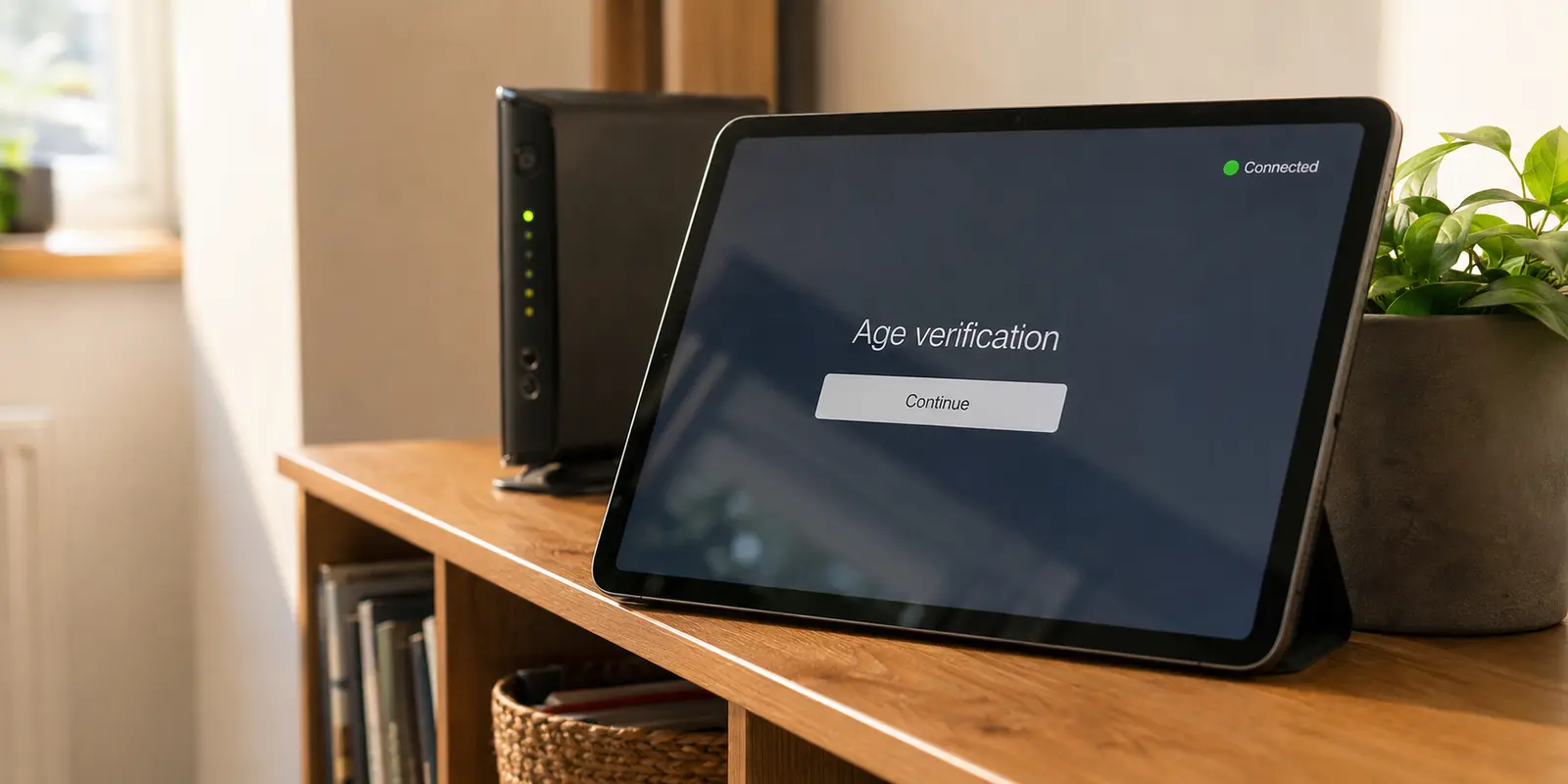
Connect to Server A, and the site immediately throws up an age-verification screen demanding an ID upload or a facial age scan. Switch to Server B, refresh, and the prompt dissolves into a standard terms acceptance—or disappears entirely. Switch to Server C, and the gate slams shut again.
Nothing about your actual birthday changed between those clicks. Your physical age is constant, yet the destination service treated you like three different people under three distinct regulatory regimes.
When adult VPN users run into this, the immediate reaction is usually confusion: Is the VPN broken? Is the site detecting my tunnel? Why does changing the server make the age check jump around like a moving target?
The answer is rarely random. When age verification behavior shifts as you switch servers, that variation is not a glitch; it is diagnostic evidence. The way the prompt changes tells you precisely what layer of identity the service is evaluating. The mistake most people make is playing "server roulette"—rapidly cycling through dozens of nodes hoping one lucky IP will make the prompt vanish—which only muddies the waters and creates an unreadable mess of conflicting technical signals.
Article summary and product fit
What does it mean when different VPN servers trigger different age-verification checks?
The pattern is useful evidence. Different countries producing different prompts points to regional policy; two servers in the same region behaving differently points to the exit IP’s geolocation or risk classification; and the same gate across many regions suggests the requirement has become tied to the account, browser session, or device rather than the network location.
What to keep in mind
- Best for: Adult users trying to understand why an age gate changes—or refuses to change—when only the VPN server changes.
- Best method: Change one variable at a time and observe the pattern instead of rapidly switching countries, browsers, protocols, and sessions together.
- Important limit: Once an actual verification flow starts, keep the connection stable. The article does not present server switching as a way to evade a legally required age check.
Product fit: OnlydogVPN fits the route-management problem when unpredictable exit routes and manual node selection are the friction; it cannot remove a legitimate age-verification requirement imposed by the site or jurisdiction. OnlydogVPN official website.
Sources used in this article: Ofcom: age-assurance expectations under the UK Online Safety Act; Discord: Age Assurance Update FAQ; MaxMind: IP geolocation accuracy; U.S. Supreme Court: Free Speech Coalition v. Paxton opinion.
The Server Changed, So the Site’s Decision Can Change Too
To make sense of the pattern, start with the most basic technical reality: a VPN alters the network identity you present to a server, but it cannot alter your actual age.
When you change VPN servers, you swap your public IP address and the geographic region tied to that IP. That matters because age verification on the modern web is not governed by one universal, borderless rulebook. Different jurisdictions hold platforms to vastly different legal standards, and websites design their access gates to comply with the rules where they believe the visitor is located.
Consider the regulatory climate in the United Kingdom. Under the Online Safety Act, services hosting adult content face strict legal obligations enforced by Ofcom to implement "highly effective" age assurance. Sites operating in or serving the UK market cannot simply ask for a self-certified date of birth; they face immense legal liability if they fail to deploy robust verification checks. If your VPN exits through a London datacenter, the service handles your traffic under the umbrella of those strict statutory mandates.
This is not limited to adult entertainment platforms or hypothetical legislation. Mainstream communication apps apply regional age gates right now. Discord explicitly documents that users connecting from regions such as the UK, Australia, and Brazil face specialized regional age-assurance requirements. When a platform detects an incoming connection originating from one of these zones, it triggers localized compliance workflows.
Changing your server changes which legal playbook the platform thinks it must follow. However, presenting an IP address from an unregulated jurisdiction does not magically satisfy an age requirement if the service determines it needs one—it merely changes the platform's initial assessment of which local compliance laws apply.
Read the Pattern Before You Switch Again
Instead of treating server switching as a lottery, treat it as an information-gathering exercise. How the site responds when you swap nodes provides clear diagnostic clues. Three distinct patterns cover almost every scenario:
- Different countries produce different age-check behavior. If routing through Germany, the UK, or Japan consistently triggers different verification screens, you are looking at jurisdiction-level policy. The service is evaluating regional compliance requirements. When the behavior correlates reliably with borders rather than individual servers, the site’s geofencing rules are doing the heavy lifting.
- Two servers in the same country produce different behavior. The governing law did not change between two servers located in the same city. If Server 1 triggers an identity prompt while Server 2 lets you pass, the issue is not the country's legal framework. The service is evaluating the individual exit IP address: its database classification, its fraud score, or conflicting regional metadata.
- Every server produces the identical age gate. If you hop across four different countries and five different networks and the exact same verification wall persists, stop switching servers. The platform is no longer looking at your network location to make this decision.
Modern platforms increasingly rely on persistent, account-level signals rather than relying exclusively on an IP address.
Discord’s age-assurance infrastructure provides a prime example: the platform documents that its age-inference systems evaluate holistic account signals, including account age, linked payment methods, server participation history, and behavioral patterns.
If a platform has already flagged your profile, session cookie, or device fingerprint as requiring verification, routing your traffic through every continent on earth will not reset that status.

Why Two Servers Under the Same Flag Can Still Look Completely Different
The second scenario—where two servers under the exact same national flag trigger completely different behavior—is often the most baffling to users. The reason lies in the gap between what your VPN client displays and what the destination server actually sees.
Your VPN interface shows a clean label: "United States - Dallas" or "Germany - Frankfurt." The destination website does not see that label. It sees an arbitrary IP address, which it runs through commercial IP intelligence databases.
IP geolocation accuracy varies wildly depending on how deep you drill down. Network intelligence authorities like MaxMind note that while country-level geolocation is generally reliable, subdivision (state) and city-level accuracy drop off substantially. MaxMind also points out that VPNs intentionally expose the location of the datacenter exit rather than the physical user.
This distinction is critical in federated nations where online age-verification laws are enacted at the state level rather than federally.
In the United States, for instance, Texas enacted an age-verification law for adult sites that was formally upheld by the US Supreme Court in June 2025 (Free Speech Coalition, Inc. v. Paxton).
If a platform enforces mandatory ID checks for visitors located in Texas but not for visitors in neighboring states, the platform relies on IP geolocation databases to determine which side of the state border you fall on.
Because state-level IP geolocation is frequently imprecise, two VPN servers located in nominally adjacent jurisdictions—or two servers whose geolocation records conflict across different databases—can trigger completely divergent enforcement rules.
Furthermore, location and classification are entirely separate data points:
Geolocation data and network classification are separate signals. Geolocation data maps an IP to a country, state, or city, which can determine which local legal rules and age thresholds apply. Network classification asks whether the address looks like a datacenter, commercial VPN, proxy, or residential connection, which can determine whether the session stays in a standard flow or is pushed into higher-friction verification.
Even if two servers resolve to the exact same city, one exit IP might be categorized by security databases as a high-reputation commercial relay, while the other might be flagged as an anonymous proxy or associated with automated traffic. If a platform uses risk scoring to decide how aggressively to verify a user, those classification differences alone can trigger an escalated verification gate.
The useful part of server switching is the pattern
When faced with an unexpected age gate, most people instinctively enter panic mode: they disconnect, reconnect, switch protocols, open a private browsing window, change countries, and click the link again—all in under forty seconds. By changing five variables at once, you make it impossible to determine what actually triggered the response.
To isolate what the website is actually reacting to, run a disciplined test:
- Isolate the node: Stay on the server that presented the unexpected prompt. Note the target country and jurisdiction.
- Change only the server: Switch to a different exit node within the same provider while keeping your browser, account session, and device identical.
- Evaluate the shift:
- If switching to a different national region consistently changes the prompt, the platform is executing a regional policy.
- If switching between two nodes in the same region alters the behavior, the individual exit IP's reputation or geolocation record is the cause.
- If changing across multiple regions produces zero difference, the age check is tied to your account state, your browser storage, or a device-level identifier.
Most importantly: once you initiate an actual verification flow, keep the connection completely stable. Hopping servers mid-verification—such as during a third-party identity check, a face scan redirect, or a wallet authorization—injects network fluctuations that can invalidate the session token, flag your account for suspicious activity, and lock you out entirely.
For adult users who find themselves stuck in manual server roulette, this constant guesswork represents unnecessary friction. This is one place where an intelligent routing client like OnlydogVPN↗ becomes relevant.
Rather than forcing you to scroll through an endless list of uncontextualized city nodes and guess which IP carries the right network profile, OnlydogVPN utilizes dedicated scenario presets and automated routing.
You specify the browsing intent, and the client handles route optimization, minimizing the IP reputation flags and erratic routing shifts that cause sites to deploy defensive verification screens in the first place.
A boundary matters here: OnlydogVPN's automated routing is built to eliminate route instability and manual server management—it cannot and will not make a legitimate, legally mandated age verification check disappear if the platform requires one for that region.
If your access needs depend strictly on a specific, obscure legal jurisdiction that falls outside its network, you should deliberately choose a service providing manual access to that specific region.
But if your daily friction stems from juggling unstable nodes and dealing with unpredictable server behavior, relying on managed route selection removes the guesswork.
What I’d take from the result
Once you run a controlled test, the pattern leaves you with a concrete decision rather than a mystery.
If changing jurisdictions changes the gate: The platform is operating under regional compliance mandates. The verification system is not malfunctioning; it is behaving exactly as designed under local law. If you are legitimately using the service within a jurisdiction that mandates age verification, your options are clear: complete the verification using an available method you are comfortable with, or decline to access the restricted material. Attempting to continuously spoof location to dodge a mandatory legal check is a losing battle against platforms with sophisticated regional compliance engines.
If same-region servers behave differently: You have successfully isolated the issue to the route itself. One exit IP likely carries an outdated geolocation tag or an elevated risk score in commercial proxy databases. Once you connect through an exit that provides a clean, stable session, stop touching the controls. Do not bounce between servers chasing marginal improvements in ping; stability is what prevents security systems from flagging your session.
If no server change alters the outcome: The VPN has ceased to be a relevant variable. The platform has bound the verification requirement to your signed-in profile, your local application state, or persistent behavioral signals. Continuing to adjust your network tunnel is useless. You must address the age requirement directly within the platform's account settings or clear the persistent session states that triggered the flag.
The productive question when dealing with modern age checks is never, "Which random server will bypass this screen?"
It is, "What did the screen do when I changed only the server?"
The answer to that question tells you whether to change your region, settle onto a stable route, or step away from the VPN controls altogether.
Frequently Asked Questions
What does it mean if age-verification behavior changes when I switch countries?
A consistent country-to-country change points to regional compliance policy. The platform is likely applying different rules based on the jurisdiction associated with the incoming IP address.
Why can two VPN servers in the same country trigger different age checks?
The law did not change between the two servers, so the more likely difference is the individual exit IP: its geolocation record, datacenter or proxy classification, reputation, or fraud score.
What if every VPN server shows the same age-verification prompt?
Stop treating the network as the main variable. The requirement may be attached to your signed-in account, session storage, device fingerprint, or other persistent platform signals.
Should I keep switching servers during the actual identity check?
No. The article recommends keeping the route stable once verification begins, because changing IPs mid-handoff can invalidate tokens, create contradictory signals, or trigger additional security friction.