
If France enacted a mandatory age-verification regime, why do none of these screens look the same?
The common assumption among residents and visitors alike is that France introduced a state-run, universal "porn pass" or an official government portal requiring you to flash your national identity card directly to the website you are trying to visit. That assumption is wrong. France does not mandate a single government age-check application, an official verification vendor, or a standardized verification screen. Instead, the law sets a strict regulatory outcome: commercial adult platforms must effectively bar minors while respecting rigid privacy safeguards.
For an adult browsing in France, the practical question is not "Which official French ID check do I have to use?" It is "Does this site offer a compliant, privacy-preserving way to prove I am over 18 without attaching my real-world identity to my adult browsing history?"
Article summary and product fit
France requires an outcome, not one universal age-check screen
France’s age-verification regime does not impose a single government app or standard visual flow. Adult platforms can use different compliant systems, but the result must be effective age assurance with privacy safeguards. The core privacy concept is separation: the adult site should learn that the user is an adult without receiving the raw identity or biometric data used to establish that fact.
What an adult user should understand
- Different screens are expected: The regulator sets technical and privacy requirements rather than mandating one vendor or one national verification interface.
- Passive self-declaration is not enough: A compliant gate needs a meaningful age-assurance mechanism rather than a simple 'I am 18' checkbox.
- Privacy matters: The article highlights independent verification and double-anonymity approaches that separate proof of adulthood from the destination site and the user’s real-world identity.
- Availability can differ by site: Some operators implement verification, while others may withdraw from France or face enforcement rather than adopt the required controls.
- Product context: The article keeps age proof and network privacy separate: OnlydogVPN is mentioned only for encrypting the surrounding connection and limiting tracking, not as a substitute for the site’s required age-verification process.
Sources in this article: European Commission preliminary DSA findings; CNIL opinion on Arcom’s age-verification framework; CNIL on double anonymity; CJEU judgment referenced in the article; OnlydogVPN official website.
There Is No Single “French Age Verification Screen”
Under France’s 2024 SREN framework, regulatory authority Arcom was tasked with defining the technical minimum requirements that adult sites must meet regarding both verification reliability and data protection. Crucially, Arcom’s framework explicitly avoids certifying a single technical solution or maintaining a closed catalogue of authorized products. The regulator outlines the performance standards; commercial operators remain free to engineer or license whichever technical systems satisfy those baseline rules.
Because the state mandates the standard rather than the software, visual and operational diversity across platforms is entirely deliberate. When you encounter an age gate, you are looking at that specific operator's chosen compliance architecture, not a centralized French portal.
In practice, your browsing experience will generally fall into one of three buckets:
- Compliant platforms: The site implements a qualifying third-party verification workflow that meets Arcom's thresholds for age gating and privacy separation.
- Withdrawn platforms: The operator decides that complying with French legal requirements is technically unfeasible or commercially unviable, and voluntarily halts services to French IP addresses.
- Non-compliant holdouts: The platform continues to rely on legacy disclaimers or minimal checks, leaving itself exposed to formal regulatory notices, financial penalties, and French court-mandated ISP blocking.
Encountering different verification screens does not mean one site is authentic and another is a scam. It simply reflects the fact that commercial vendors are competing to solve the same regulatory mandate.
What Every Compliant Gate Has to Accomplish
Beneath the varied interfaces, every legitimate verification system must satisfy non-negotiable legal baselines.
First, the entry gate must be an absolute barrier: adult material cannot be visible in the background, obscured behind faint blur filters, or accessible while the verification interface loads.
Second, passive confirmation is dead. A simple checkbox or button declaring "I am 18 or older" does not constitute age verification under French law. Regulators across the continent share this stance; in March 2026, the European Commission’s preliminary findings under the Digital Services Act underscored that self-declarations and passive warning prompts on major platforms like Pornhub, Stripchat, XNXX, and XVideos fail to meet the standard of effective protection for minors.
Third, the underlying mechanism must reliably differentiate between an adult and a minor while incorporating active defenses against trivial spoofing, circumvention, and shared or reusable proof tokens.
Most importantly, French law requires the operator to establish proof of adulthood, not to collect the user’s legal identity. The adult platform has a legal duty to confirm that an adult is sitting behind the browser, but it has no lawful right to know who that adult is.
Proving Adulthood Without Handing Over Your Identity
The central friction point of age verification has always been privacy: nobody wants their legal name, national registry number, or home address permanently tethered to their private viewing habits. France’s regulatory framework addresses this conflict through strict architectural separation.
Under Arcom’s guidelines and supporting opinions from data privacy watchdog CNIL, the age-verification provider must remain legally and technically independent of the adult-content service. The adult site is strictly prohibited from receiving or storing the underlying raw data—such as an identity document or raw biometric data—used to confirm adulthood. The site receives only a cryptographic attestation: a verified "yes" or "no."
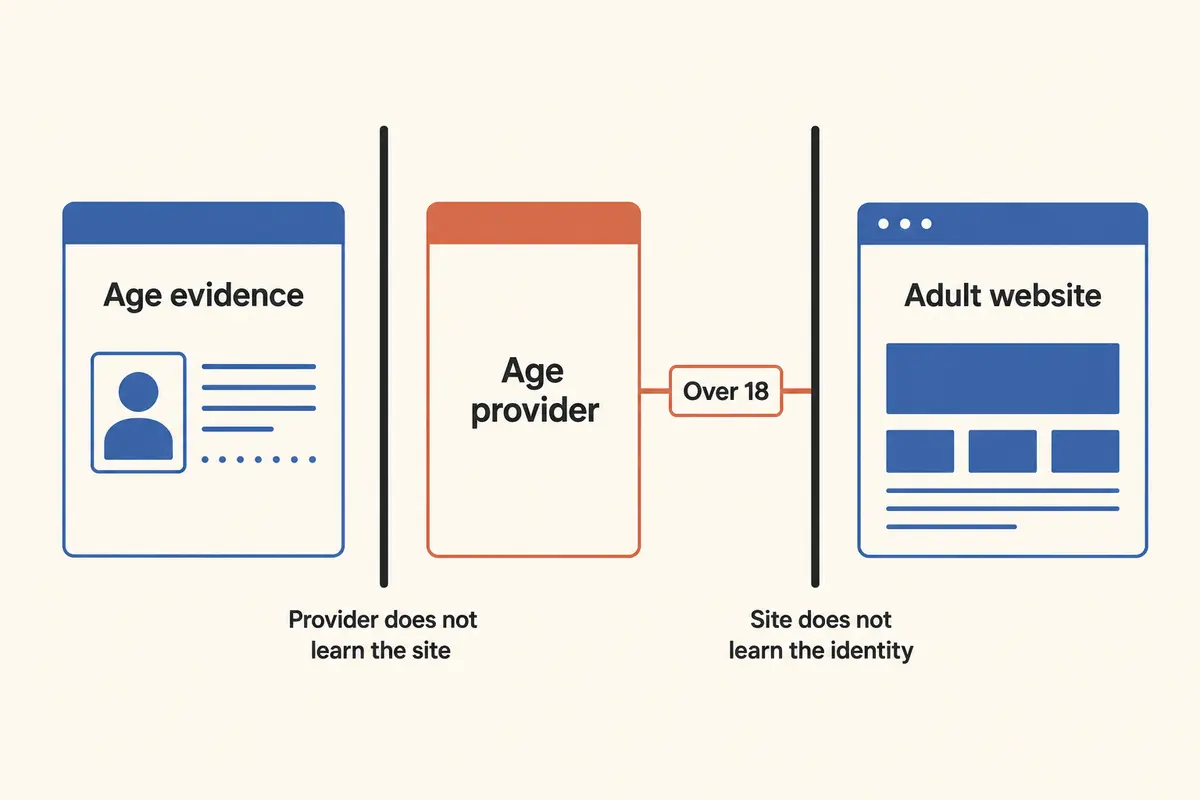
To go a step further, the framework requires covered platforms to offer at least one verification option that satisfies an enhanced standard known as double anonymity:
- To the adult website: The destination service learns that the visitor has proven they are 18+, but learns zero personal identifying details about that visitor.
- To the verification provider: The identity service that verifies the user's credential or age estimation never learns which adult platform the user is trying to access.
The double-anonymity flow: The browser asks an independent verifier for age proof without revealing the destination site. The verifier returns a cryptographic 18+ attestation, and the browser presents that token to the adult website without handing over the user’s real-world identity.
"Double anonymity" is a regulatory framework term rather than an assertion of zero-data processing in the strict GDPR sense; the third-party provider inevitably processes your source credential to generate the attestation. However, the architecture prevents the creation of a unified digital surveillance record that pairs your legal identity with specific adult websites.
The practical takeaway for users is straightforward: if an adult platform immediately demands a passport or national identity card upload, do not assume that is your only route. Regulators require services to present clear privacy labeling and provide widely accessible, privacy-preserving paths. Check the alternative options on the gate; you will frequently find privacy-focused routes such as estimation tools or blind digital tokens that satisfy the requirement without collecting your personal documents.
Why One Site Checks Age While Another Simply Vanishes
If the regulatory pathway exists, why do certain websites simply refuse to load?
Enforcement of the SREN rules has moved decisively from theory into daily practice. On June 16, 2026, the Court of Justice of the European Union (CJEU) handed down a key ruling confirming the specific conditions under which French authorities can legally enforce national age-verification requirements against services established in other EU member states. This removed significant legal ambiguity regarding cross-border enforcement inside the European single market.
Shortly thereafter, in late July 2026, Arcom escalated its enforcement by launching formal proceedings against 31 additional adult platforms operating without required safeguards—its largest consolidated enforcement action to date.
When an adult site simply drops offline for French users, it does not mean your internet connection is broken or your browser is failing. It usually means the platform operator has assessed the legal risk, the operational cost of integrating compliant third-party verification, and the strict technical standards of Arcom, and opted to geoblock France entirely rather than implement a double-anonymized verification architecture.
What I’d keep in mind at the age gate
When confronted with an age check on an adult website, treat it as a routine technical step rather than a reason to scatter unredacted identity documents across the internet.
1. Verify the Origin
Ensure the verification screen is an integrated part of the legitimate website you intended to visit. Be wary of unprompted redirects, aggressive new tabs, or untrusted pop-ups attempting to harvest personal data under the guise of an "official check."
2. Select the Least Intrusive Verification Method
Examine the available verification methods instead of clicking the first available button. Prioritize routes marked with enhanced privacy or double-anonymity protections. An estimation tool or an independent privacy token provider that isolates your credentials from the site is vastly preferable to an unmediated document capture.
3. Maintain a Stable Network Connection
Because the verification workflow relies on a secure cryptographic handshake between your browser, the independent verification provider, and the adult website, keep your connection steady. Shuffling locations, changing network adapters, or forcing aggressive browser refreshes during token generation will typically break the verification flow and reset the gate.
4. Protect the Network Around the Session
It is critical to distinguish between your connection layer and your age proof. A Virtual Private Network (VPN) encrypts your data in transit and conceals your home or mobile IP address from websites and network operators; it does not, however, prove that you are over 18 years old. A VPN is not an age-verification tool, and an age gate is not a network shield.
For adults looking to maintain comprehensive privacy during a lawful browsing session, pairing verification with a clean, low-friction privacy tool makes sense. OnlydogVPN is one option for this network-privacy role. Rather than forcing you to configure intricate tunneling parameters or troubleshoot broken routes while navigating verification handoffs, OnlydogVPN delivers streamlined connection presets engineered for seamless privacy. Its account architecture is designed around data minimization, and its integrated ad- and tracker-blocking stops third-party telemetry scripts from harvesting your device footprint while you navigate between the verification provider and the destination site.
The division of responsibility is clean: use the site's compliant double-anonymity gate to resolve the age check, and use OnlydogVPN to shield your connection, mask your IP, and eliminate tracking scripts around the session.
France is not building a centralized government registry of adult web traffic. The 2026 rules demand that websites keep minors off adult platforms while respecting user privacy through structural separation. When an age gate appears, you do not need to choose between surrendering your privacy and closing the tab—you simply need to select the most privacy-preserving proof available.
Frequently Asked Questions
Does France have one official government age-verification app for adult sites?
No. The article explains that France sets the compliance standard, while individual sites can choose different verification technologies or vendors that satisfy those requirements.
Why do different adult sites in France show different age-check screens?
Because the regulator does not prescribe one interface. Each operator can implement its own compliant workflow, which is why one site may use facial age estimation, another a digital identity provider, and another may simply stop serving French users.
Does a compliant age check require the adult website to know my identity?
No. The article emphasizes that the site needs proof that the visitor is an adult, not the raw identity data used to establish that proof.
What does double anonymity mean in this context?
It means the adult website receives an 18+ attestation without learning the user’s identity, while the verification provider verifies the user without learning which adult site the user is trying to access.
Can a VPN replace France’s age-verification process?
No. A VPN can protect the network connection and IP privacy, but it does not prove age. The site’s compliant age-verification step and the VPN’s network-privacy role are separate.