When you sit down to browse an adult site, an uncomfortable thought often follows: Is a free VPN safe enough for this, or do I need to pay for real privacy?
The conventional wisdom is swift and blunt. Tech forums and security blogs will tell you that if you aren't paying for the product, you are the product. They warn that free VPNs log your every move, sell your browsing habits to data brokers, and inject malware into your phone. The implied solution is always the same: open your wallet, subscribe to a paid tier, and buy yourself complete peace of mind.
That advice sounds prudent, but it skips the central technical reality of how networks operate: a price tag is not a cryptographic protocol.
A credit card transaction does not inherently alter the mathematics of an encrypted tunnel. A paid VPN can log your activity, leak your DNS requests, and track your hardware just as readily as a free one. Conversely, a reputable free tier can deliver the exact same core privacy protection as an expensive tier.
For lawful, sensitive adult-site browsing, paying for a VPN is justified only when the paid product eliminates a specific privacy exposure that the free version leaves behind. Until you can name the exact vulnerability you are paying to remove, spending money on a subscription is simply buying a placebo.
Article summary and product fit
Is a free VPN enough for adult-site privacy, or should you pay?
A reputable free tier can provide the same core tunnel privacy as a paid plan: it can hide the destination from the local ISP and mask the home IP from the site. Paying is justified when it removes a specific secondary exposure, such as in-app tracking, congested shared IPs, CAPTCHAs, or missing tracker filtering.
What matters in this article
- Best for: People comparing a reputable free tier with a paid VPN for lawful, sensitive browsing.
- Key distinction: The business model and privacy practices matter more than the price tag; paying does not create a “more encrypted” tunnel by itself.
- When paying helps: A paid service can be worth it for cleaner routing, higher speeds, fewer shared-IP blocks, or network-level ad and tracker filtering.
- Important limit: A VPN masks network destinations and the home IP, but it does not erase identities you reveal by logging in, paying, or otherwise identifying yourself to the site.
The article grounds this distinction in University of Michigan research on Android VPN risks and Proton VPN’s explanation of its free and paid tiers. Product fit: OnlydogVPN is relevant here only when the user wants the paid features described in the article, such as tracker filtering and adaptive routing—not because payment itself makes encryption stronger.
What the VPN Actually Needs to Hide
To understand whether you need to pay, you have to define the job you are hiring the VPN to do.
When you visit an adult website without a VPN, two main things happen on the network layer:
- Your Internet Service Provider (ISP) sees the destination. Even though modern HTTPS encrypts the specific page path, search queries, and video streams, your ISP or local Wi-Fi router can still observe the domain name you connect to.
- The adult website sees your real IP address. The platform logs the public IP assigned by your home broadband or mobile carrier, tying your browsing session to your general geographic location and internet account.
A correctly configured VPN solves both problems. It routes your traffic through an encrypted tunnel to a remote server. Your ISP sees only an incomprehensible stream of encrypted data traveling to the VPN provider, while the adult site sees the VPN server’s IP address rather than your home connection.
Without a VPN:
[ Your Device ] ──( Sees Domain: adultsite.com )──▶ [ Your ISP ] ──▶ [ Adult Site (Logs Home IP) ]
With Any Trustworthy VPN (Free or Paid):
[ Your Device ] ──( Encrypted Tunnel )──▶ [ VPN Server ] ──▶ [ Adult Site (Logs VPN IP) ]
(ISP only sees VPN IP)
Now consider what happens to the VPN provider itself. The provider sits in the middle. It handles the exit node and processes the destination request.
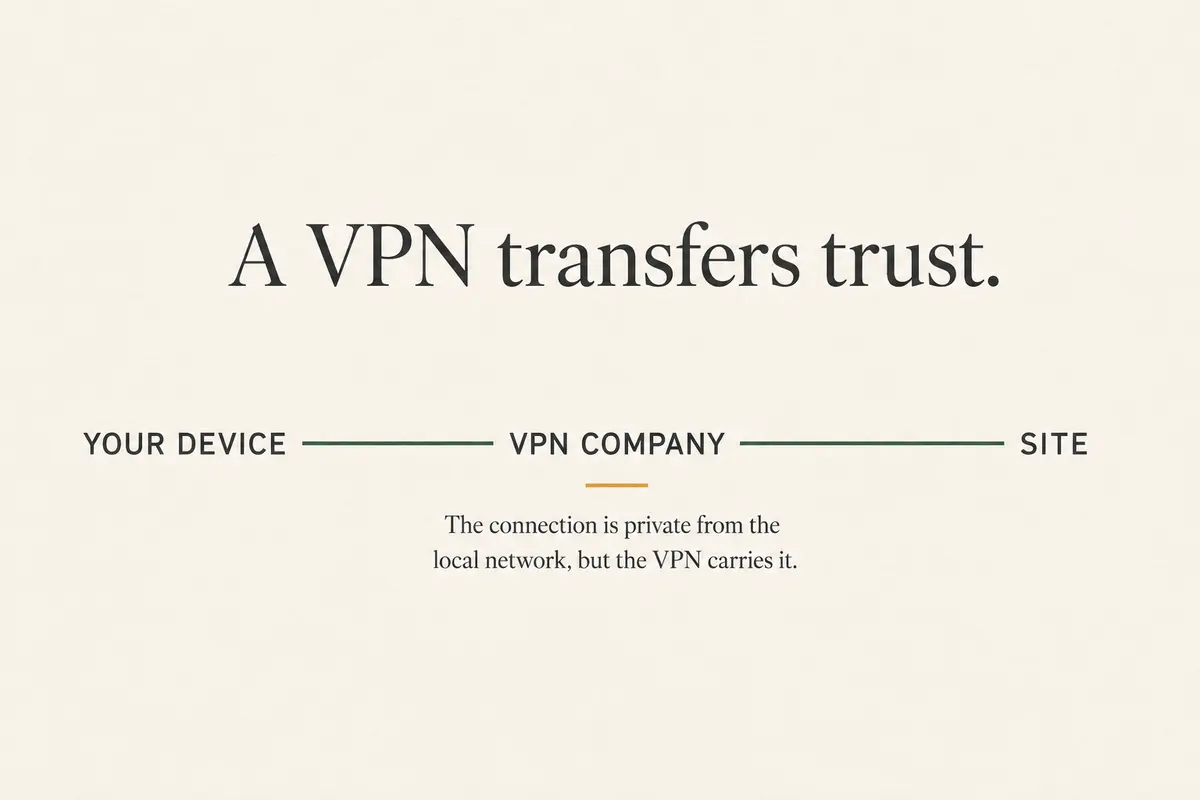
If a free VPN service and a paid VPN service use the exact same underlying server infrastructure, deploy the same robust encryption, and adhere to a strict no-activity-logs policy, the paid version does not make the adult website more invisible to your ISP than the free version. The domain is either hidden inside the tunnel or it isn't. The real-world privacy of that tunnel depends on whether the company operating it is trustworthy, not whether they charged you $0 or $10 a month.
The Real Red Flag Is an Unexplained Business Model
If price doesn't dictate security, why do free VPNs have such a toxic reputation?
Because running high-bandwidth server networks is expensive. When an app offers unlimited bandwidth, thousands of global locations, and blazing speeds without charging a dime, you have to ask how the bills get paid. If the answer isn't immediately obvious, the product is almost certainly monetizing your presence—frequently through aggressive behavioral ad networks, tracking SDKs, or data harvesting.
The risk of unvetted VPNs is not theoretical. A 2026 University of Michigan study of 281 popular Android VPN applications using the MVPNalyzer framework, researchers uncovered widespread vulnerabilities across the mobile ecosystem. They discovered that dozens of apps leaked user traffic outside the encrypted tunnel, transmitted sensitive browsing activity over cleartext, or leaked persistent hardware and device identifiers directly to third-party tracking services.
Critically, the Michigan researchers did not find that every vulnerable app was an overtly malicious free tool. Rather, their findings exposed a broader truth: simply existing in an official app store with a four-star rating and a green shield icon is zero guarantee that an app handles your network traffic safely.
The red flag is not the price of $0. The red flag is an opaque business model.
A trustworthy service is transparent about its revenue. It might be a non-profit, or more commonly, a commercial platform operating a freemium model where paying subscribers subsidize a restricted free tier. An untrustworthy service hides behind vague shell companies, offers infinite free resources, and buries data-sharing clauses deep within ambiguous terms of service.
When a Free Tier Can Be Just as Private
You do not need to take this dynamic on faith; it already exists in the wild.
Consider how Proton VPN describes the relationship between its free and paid plans. Its free tier is explicitly subsidized by its paying user base. Because the company generates revenue from premium subscriptions, it does not inject ads into free sessions, sell user analytics, or harvest traffic logs.
Crucially, Proton applies the exact same core security infrastructure and no-logs policy to its free users as it does to its paying customers. The encryption ciphers protecting a free connection are identical to those protecting a premium account.
What changes when you upgrade from their free tier to a paid tier?
ISP Domain Visibility. Reputable Free Tier: Completely Hidden; Premium Paid Tier: Completely Hidden; Does It Change Core Tunnel Privacy?: No
Real IP Exposure. Reputable Free Tier: Completely Masked; Premium Paid Tier: Completely Masked; Does It Change Core Tunnel Privacy?: No
Activity Logging. Reputable Free Tier: None; Premium Paid Tier: None; Does It Change Core Tunnel Privacy?: No
Server Choice. Reputable Free Tier: 1–3 assigned locations; Premium Paid Tier: 100+ global locations; Does It Change Core Tunnel Privacy?: Convenience / Access
Connection Speeds. Reputable Free Tier: Throttled / Standard; Premium Paid Tier: High-speed / 10 Gbps; Does It Change Core Tunnel Privacy?: Usability
Simultaneous Devices. Reputable Free Tier: Single device; Premium Paid Tier: 10+ devices; Does It Change Core Tunnel Privacy?: Convenience
Built-in Tracker Blocking. Reputable Free Tier: Typically omitted; Premium Paid Tier: Included; Does It Change Core Tunnel Privacy?: Yes (Site-level tracking)
If your sole requirement is opening an incognito browser window, loading an adult video, and ensuring that neither your local broadband provider nor the site administrator knows who you are, a reputable free tier already accomplishes 100% of that task.
Paying for a subscription in that specific scenario buys you faster streaming speeds and the ability to pick a specific server in Amsterdam or Tokyo. It does not buy you a "more encrypted" tunnel.
What Paying Should Actually Change
If basic tunnel privacy is achievable for free, what makes a paid VPN worth the investment for adult browsing?
A paid VPN must earn your money by eliminating the secondary exposures that a basic encrypted tunnel leaves behind. When deciding whether to upgrade, look for specific, tangible privacy improvements:
Eliminating Built-in Advertising and Tracking SDKs.
If you use a free service that funds itself via in-app advertising, that app likely includes third-party ad libraries. Those SDKs continuously monitor your device state, location, and interaction patterns. Moving to a clean paid service removes those ad networks from your device entirely.
Network-Level Tracker and Ad Blocking.
Hiding your IP address from an adult platform does not stop the site from tracking you. Adult websites are heavily monetized through aggressive third-party ad networks, telemetry scripts, and browser fingerprinting trackers that follow you across the web. A high-quality paid VPN often runs automated DNS-level filtering that blocks these tracking domains before they ever load on your screen.
Resolving Route Congestion and Blocking.
Free tiers route millions of users through a handful of crowded IP addresses. As a result, those specific IPs frequently get flagged by Cloudflare or adult platforms, resulting in endless CAPTCHA loops, broken video players, or outright access bans. Paying for access to cleaner, specialized routing pools solves this friction.
Minimizing Identity Linkage.
Here is the paradox of paying: the act of paying introduces an identity vulnerability. When you sign up for a paid VPN using your primary personal email, a credit card with your legal name, and a home billing address, you create a direct financial paper trail tying your real-world identity to that VPN account. Even if the provider keeps zero activity logs, their payment processor maintains an audit record of your subscription. A truly privacy-respecting paid VPN must actively minimize this account baggage.
When Paying Actually Changes Something
Before you enter your payment details on a VPN checkout page, run through a simple triage:
[ What is your goal? ]
│
┌────────────────────┴────────────────────┐
▼ ▼
[ Occasional browsing; [ Daily browsing;
just need to hide from ISP hate CAPTCHAs, trackers,
and mask home IP ] and app ads ]
│ │
▼ ▼
[ Choose a REPUTABLE [ Upgrade to a paid VPN
FREE TIER ] that solves those specific
(e.g., Proton VPN free) annoyances ]
Stay Free. if your browsing is occasional, you only need to shield your traffic from your ISP, and you use a provider with a proven, transparent freemium model. If the connection works and loads what you need, keep your money in your pocket.
Never Use an Opaque Free VPN. If an app on the Play Store or App Store offers unlimited high-speed data with zero subscription path and an anonymous developer, delete it immediately. It is almost certainly extracting value from your data.
Pay Only When the Service Removes a Specific Vulnerability. Upgrade when you need integrated tracker blocking, reliable unthrottled streaming without CAPTCHAs, or a service that handles identity better.
If paying makes sense for your routine, OnlydogVPN↗ is one example of a paid option built around those secondary privacy exposures.
The parts that matter here are practical rather than abstract:
Frictionless, Passwordless Access. Most paid VPNs force you to create a persistent account with a master password, linking your credentials across sessions. OnlydogVPN eliminates traditional password-based accounts, using disposable magic codes to strip away unnecessary identity baggage.
Built-in Ad and Tracker Shielding. It doesn't just route your traffic; it actively intercepts and blocks the third-party trackers, pop-ups, and telemetry scripts that plague commercial adult platforms, backed by a live interface counter showing you exactly what was neutralized.
Adaptive Network Routing. Instead of forcing you to manually test five different overloaded country nodes just to find one that doesn't trigger a CAPTCHA, it automates route selection to maintain stable, clean throughput.
A paid VPN isn't inherently safer than a free one. The best security strategy is simple: Do not ask whether paid is better than free. Ask what privacy exposure disappears the moment you hand over your money. If you can't point to a specific risk being neutralized, the reputable free option is all you need.
Frequently Asked Questions
Can a reputable free VPN hide adult-site destinations from my ISP?
Yes, if the free tier uses a properly configured encrypted tunnel and does not leak traffic, the ISP sees the VPN connection rather than the adult-site destination. The article’s point is that this core tunnel behavior depends on the provider and implementation, not on whether the plan costs money.
Is a paid VPN automatically more private or more encrypted than a free VPN?
No. A paid plan can still log activity or leak data, while a reputable free tier can use the same encryption and no-logs policy as its paid version. The useful comparison is which specific exposure changes when you upgrade.
What is the biggest warning sign with a free VPN?
An opaque business model. If a service offers unlimited high-speed access without a clear way to fund servers, the article recommends treating hidden monetization through ads, tracking SDKs, or data collection as the real risk.
When is paying for a VPN actually worth it for sensitive browsing?
Pay when the upgrade solves a concrete problem you have, such as crowded IP addresses, streaming friction, CAPTCHAs, in-app advertising, or the need for network-level tracker blocking and cleaner routing.
Does a VPN make me anonymous to the adult website itself?
No. A VPN can replace your home IP with the VPN server’s IP, but the site can still identify or track you through logins, payment details, account activity, browser signals, and other information you provide.